Woods electric car clinton e woods antique electric car vintage electric car
Woods Motor Vehicles
For information about Woods models, please see the U-Z webpage
Woods branded vehicles were made by:
· The Fischer Equipment Company, 1897-1899
· The Woods Motor Vehicle Company, 1899-1919
Most successful electric car companies had fairly stable ownership, management, and engineering staffs. Woods went through many changes, and Clinton E. Woods was gone before things really got rolling; yet the brand hung on.
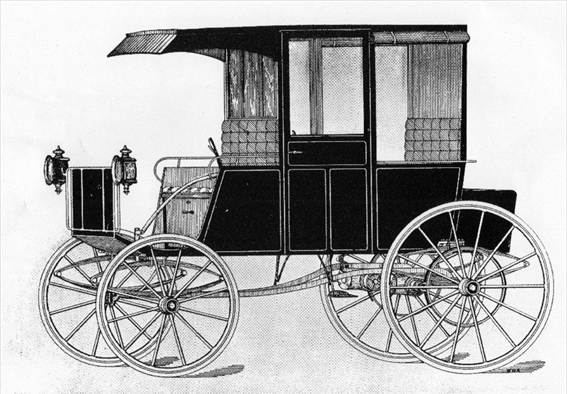
No. 16 – Woods Electric Station Wagon
In 1896 the American Electric Vehicle Company of Chicago made a batch of six vehicles designed by co-founder Clinton E. Woods. The Elgin Sewing Machine & Bicycle Co. made the chassis’ and the Fischer Equipment Company built the bodies. Woods’ partners at American hired a second engineer, Karsten Knudsen, in October of 1896. He designed a controller and a more efficient single motor design (US pat. #613,420, filed June 18, 1897). The Knudsen design was also used in the first Waverley, and then the National, electric cars.
Clinton Edgar Woods left American Electric in 1897, and started an eponymous electric car brand as general manager of the Fischer Equipment Co. In 1898, the Fischer Equipment Co advertised electric vehicles under the Woods brand in a dazzling array of 20 body styles. They also sold components advertised as “Woods’ Electrical Equipments,” such as motors for road and marine applications, steering knuckles, motor controllers, Willard Batteries, and reversing switches.
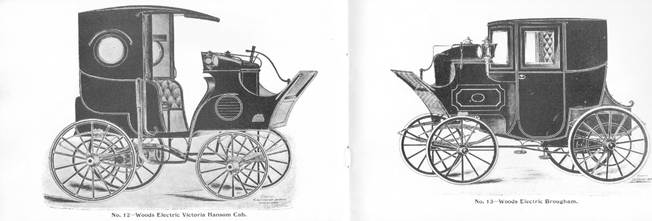
No. 12 Electric Victoria Hansom Cab (Left) and No. 13 Electric Brougham (Right)
The early Woods vehicles were of twin motor design, with rawhide spur gears on the motor shafts driving large outside-toothed ring gears at the rear wheels. Built in the carriage building tradition, with forged steel chassis’ rather than the steel tube frames preferred by former bicycle builders. Rawhide pinion gears were used as they were much quieter than straight-cut pinion gears and less fussy about alignment. They required frequent replacement, which was easy as they were accessible. Ads stated “Susceptible of operation and care by the same class of servants now employed.”
Fischer got orders from Honolulu, Paris, Antwerp and London. The United States Express Company ordered some “money wagons.” There was little competition other than Columbia and Waverley. After the handful of prototypes American never quite got into full production. For Woods things looked very promising.
When a Count de Jotemps, representing the “American Motor General Agency” of Paris, contacted him his pitch fit Woods’ belief that battery electric road vehicles would match the success of electric trolley cars. American newspaper readers knew of the “Count,” as he had recently wed a wealthy Boston widow named Bennett. De Jotemps viewed a Boston, Massachusetts vehicle competition that was won by a Woods Electric. The Count took a train to Chicago and asked Woods to meet him at the Auditorium Annex Hotel. After a vehicle demonstration; he declared them to be the best motorcars in the world, and signed a warrant for five thousand vehicles, of all twenty varieties, at 500 units per year over the next ten years; a five million dollar contract. Delivery was to start with 50 vehicles on February 1st, 1899. Jotemps was to open sales offices in Paris, London, Brussels, Vienna, and Berlin. The Count also made agreements with the Stanley brothers, the Overman Wheel Co, and the Hollyoak Motor Works. Fischer/Woods publicity trumpeted that “major European sales orders confirmed the worth of their product.”
Jotemps turned out to be a con-artist who preyed on wealthy widows using his automobile exploits as a front to make him look like an important businessman.
Woods sold the dream to his investors. That October Fischer announced expansion of facilities. In February 1899 they leased a four-story building at 118 East 20th Street and outfitted it with the machinery necessary for making electric vehicles from scratch. All significant components, including the motors, were made at the factory. Tires, hardware, and lighting fixtures, were outsourced. By that February, 60 vehicles, in 14 of the 28 models offered, “Had been put to wood and iron.”
The Count’s huge contract was a mirage, and Woods had expanded production capacity to fill orders that might never come.
There were some good reasons to be optimistic. East coast robber barons, headed by notorious monopolists such as P. A. B. Widener, W. W. Gibbs, W. C. Whitney, T. F. Ryan, and A. N. Brady, were on the move; buying assets to build electric taxicab monopolies in major cities, complementing their profitable urban rail monopolies. Gasoline vehicles were not reliable, and steam was hard to keep ready for immediate service. Count or no-count, battery cars looked to be the next big thing.
The battery cab concept was introduced to Americans by the first dozen electric cabs for hire, put on the streets of Manhattan by Morris & Salom, based on their 1895 Electrobat II design, in March of 1897.
The press was full of stories about the big cartel being formed by financiers from Philadelphia and New York to run battery cabs based on that small Manhattan line. The robber barons had locked up control of the Electric Storage Battery Co, which had an American monopoly on the pasted-plate lead-acid battery. They hoped that by controlling who used their battery they could create a functional monopoly over the motor cab business.
In Chicago, these developments were of great interest to Woods, with considerable factory capacity and far short of anticipated orders.
They were also of interest to Samuel Insull. Insull emigrated from England to work for Thomas Edison, eventually coordinating Edison’s far-flung business enterprises. Insull, and Edison’s financier Henry Villard, were instrumental in getting all of Edison’s electrical manufacturing and central power station investments under a single umbrella to make them more manageable. This became the Edison General Electric Company. The Thompson-Huston Company was of similar valuation, and their president, Charles A. Coffin, in cahoots with J. P. Morgan, who owned many of Edison’s patents, proposed a merger. In 1892 this became the General Electric Company.
Although Insull was offered an executive role at the new company, Chicago Edison asked him to recommend a new President, and he recommended himself. They accepted, and he became the President of Chicago Edison (ComEd), at a third of the GE salary. When he took over, the company had less generating capacity than the recent 1893 World’s Columbian Exposition, located just south of the city. Insull transformed Chicago Edison into a regional power giant, he was always hunting for new electric customers, especially ones that used power when most lights were off. The cable car, streetcar, and elevated electric-rail systems of Chicago all had their own power plants (before 1907).
The holding company for the “lead-cab” syndicate was called the Electric Vehicle Company. EVC either bought, or was rumored to be buying, any number of electric vehicle makers and coach building companies to produce the thousands of cabs they planned on running. EVC started with Albert A. Pope’s Columbia Motor Carriage Co, which he split off from his other enterprises for the deal.
From April through June of 1899 the press was flooded with conflicting announcements of big deals regarding various combinations of tie-ups involving Woods and the Fischer Equipment Company; with the Electric Vehicle Company, Samuel Insull, American Electric, and Siemans-Halske. Bodies were to be made by Fischer, or Studebaker (which did make 100 Columbia cab bodies).
Most of these rumors, except the EVC purchase of Siemens-Halske of America, proved to be false.
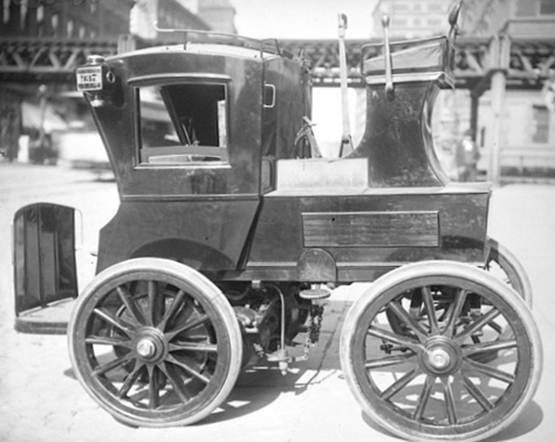
1898 EVC Hansom Cab
Insull set up the Chicago Electric Vehicle Co, in collaboration with the Electric Vehicle Company. They had EVC cabs running in Chicago on September 13, 1899.
As big money flowed into the Electric Vehicle Company’s lead-cab syndicate, business interests in Chicago, as well as Canadians in nearby Toronto, started putting together a coalition to challenge the EVC monopoly.
On September 28, 1899, the Fischer Equipment Company was recapitalized as the Woods Motor Vehicle Company, and incorporated under the laws of New Jersey, with a closed and fully subscribed stock issue of $10 million, of which $2.5 million was 7% preferred.
The new Woods Company’s impressive list of directors included Frederic Nicholls, Canadian General Electric, VP; Charles Miller, Standard Oil Co; George A. Cox, Canadian Bank of Commerce, president; Harvey Prentice Dwight, Great North-Western Telegraph Co, president; John W. Mackay, Commercial Cable Co, president; Dr. W. Seward Webb, Vermont rail Barron (married a Vanderbilt); Alfred E. Ames, Toronto investment broker; August Belmont Jr., heir; Joseph W. Flavelle, Canadian pork packer; Henry A. Ware, North-Western National Bank, VP; E. B. Osler, Member of Parliament and Dominion Bank vp; attorney Benjamin V. Becker; W. D. Mathews, Canadian Pacific Railway, director; and Sir William C. Van Horn, Canadian Pacific Railway, chairman.
Frederic Nicholls became president; J. Wesley Allison and A. E. Ames, VPs; A. E. Chandler, secretary; G. H. Atkin, treasurer; with Woods as general manager.
On December 4th, 1899, an independent cab operating company, with some shared ownership, was incorporated at $400,000 as the Woods Motor Cab Co of Chicago Illinois. Woods got around the EVC’s Electric Storage Battery monopoly by using Willard etched-plate cells, which had a bit less capacity, but no worry of lead paste shedding. They ran Woods vehicles exclusively, putting 25 cabs on the streets in mid-December, with 25 more planned for January. Cab service based on Woods vehicles was also set up in other cities; including New Haven, New York City, Toronto, and Buffalo. The Toronto cabs were made at the Canadian GE factory in Peterborough, Ontario to avoid a 30% import duty.
Both the EVC & Woods cabs drove the wheels directly by spur gears on the motor shafts engaging large ring gears at the wheel hubs. This required mounting the heavy electric motors to the axles to keep the gears meshed. The Horseless Age reported in the May 15th 1901 issue that among the many reasons––especially tire trouble––blamed on the failure of cabs in Chicago; that the one being overlooked was the failure of this gearing. With the hammering of motors by wheels bouncing over ruts and cobblestones, it was nearly impossible to keep the gears in alignment for any length of time. This and unsprung weight led to chain-drive designs.
Business for Woods was picking up. They shipped nine carloads to New York, and on February 23, 1900 they shipped 21 Surreys, one Break, and five Road Wagons to the Hawaiian Automobile Company of Honolulu. Seven rail cars were required for the trip to the Pacific, with batteries taking up a car and a half. This shipment was valued at $60,000. Woods was also building three 14-passenger omnibuses for the New Haven Cab Co.
Insull’s EVC-based Chicago Electric Vehicle cab operation had a modest running profit, but he pulled the plug on March 11th 1901, as income did not justify the capital involved. Company management blamed the bad roads of Chicago for breaking their Columbia/EVC cabs. A driver’s strike on March 2nd was the final straw. At liquidation the company owned 109 vehicles, quite short of expectations.
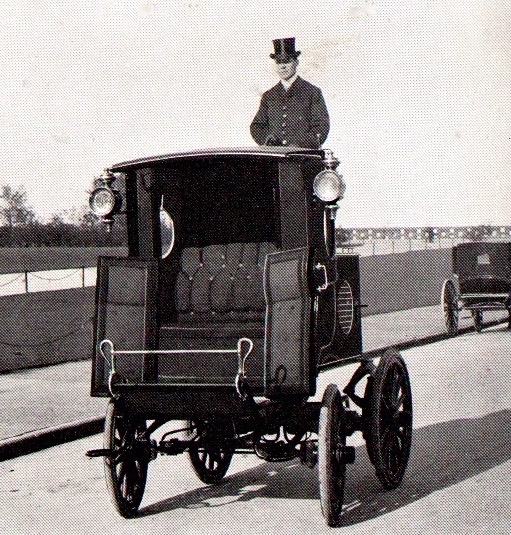
1903 Woods Hansom Cab
The Woods-based cab operation was slightly more successful and went on a bit longer. Although the Woods design was not ideal for coping with the rough roads of Chicago, Woods cabs were slightly better than the Columbia cabs in this head-to-head competition.
Woods issued a press release declaring that “the finest electric Victoria in the world” was to be made for William K. Vanderbilt, at a price of $5,000.
In August 1900, C. E. Woods quit and S. J. Moore of Niagara Falls succeeded him as manager. Woods then co-founded Woods-Waring & Co in January 1901, intending to manufacture a line of vehicles under the “Clinton E. Woods” brand. He no longer had rights to his old patents, so he came up with a new drive using a single motor attached to the axle. The design incorporated dynamic braking. Examples were announced of two open bodied models, an enclosed cab, and three delivery trucks, detailed in a fancy brochure with drawings and descriptions. Although they advised the press of orders for 100 cabs and omnibuses, the company apparently couldn’t finance production. C. E. Woods gave up a year later and accepted a job as sales agent for the Penn Rubber Co; eventually becoming a factory management consultant and publisher of technical books.
On September 27, 1901, the Woods Motor Vehicle Co went into receivership. The assets were thought to be worth $250,000, with liabilities of less than $120,000. The business was apparently profitable on a cash flow basis, but unable to sustain payments on the huge debt; with a fixed annual cost of $140,000. Manufacturing at 545 Wabash Avenue and 110-118 East Twentieth Streets was expected to cease. The repair department was to remain open.
On October 25, 1901, a fire at the Wabash Avenue factory caused a $75,000 loss, including 22 vehicles from the lot of 27 sent to Honolulu, which had been returned for repair (a bad sign). Some 60 cars were saved, but the fire destroyed patterns and completed body frames, along with lumber stored on the top floor. By the end of October the company was in the hands of receivers.
Woods moved its offices and salesroom to the East Twentieth Street facility on November 23rd, 1901 while “completing” repairs to the fire damage at the Wabash Avenue factory, The Wabash location was probably abandoned as the address was not used thereafter.
On July 2nd, 1902, the Woods Company’s assets were sold at auction in seven lots to railroad heir Jay Dixon Chappell.
1. Finished vehicles.
2. Vehicles in the process of construction.
3. Parts of vehicles, castings, patterns, and miscellaneous supplies.
4. Machinery and machine tools.
5. Patents, trade names, corporate name and all rights and goodwill.
6. Accounts and bills receivable.
7. Any other property and assets (the factories were leased).
On August 7th, 1902 Chappell reincorporated the Woods Company with $150,000 in capital. He continued the business at the East 20th Street factory, using C. E. Woods’ two-motor drive design.
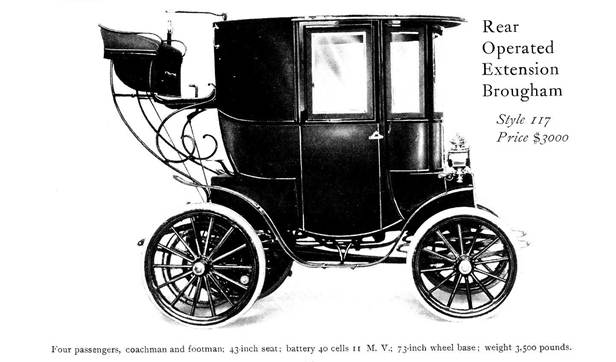
Style 117 Rear Operated Extension Brougham
Frederick J. Newman, from the Hub Motor Transit Co, was hired to replace Woods as chief engineer. He was put to work designing a more efficient and reliable single motor drive system.
On September 18th 1905, 30-year-old J. D. Chappell died suddenly of tonsillitis, which could be fatal before antibiotics. His wife, May L. Chappell, apparently continued his plans for the company. A new factory, financed by landlord O. H. Stone, had been contracted. The lease was for ten years at $9,000 annually, reducing the need for upfront capital. It was built at a point of land where the angular Cottage Grove Avenue ran into Calumet Avenue at East 25th Street. The land was purchased in the fall of 1905 for $25,000, and the building cost was projected to be $75,000. The factory, of semi-mill (heavy timber with masonry walls) construction, stood four-stories tall and was divided into four walled-off sections. The general offices were at the nose of the building, with three streets wrapping around it. The fire must have been vivid in Company memory as the forges were now in a separate building, and the local fire station was directly across the street. Unlike most electric car factories of the time, it had no power plant. Chicago Edison provided reliable power at the second lowest rates in the nation; after Buffalo, New York, which was supplied by Niagara Falls. Chicago Edison had a long term coal contract at a good price, with efficient bulk transportation by ship.
The new factory began operation in April of 1906. The new-new Woods Company was ramping up to make eight electric and two gasoline models. Newman’s new drive design was similar to that of many twin-chain cars, and not hampered by active patents. It had a single motor, using herringbone reduction gears through jackshafts to twin chains, greatly reducing un-sprung weight and gear alignment problems. The rear suspension was like the Columbus Electric, with a transverse leaf spring at the inner ends of a pair of three-quarter elliptic springs. The 214 Queen Victoria was the flagship of Woods’ new line. With the optional removable Coupé top, it became a literal convertible called a 214a Brougham. Outside drive Coupés driven by servants fell out of favor.
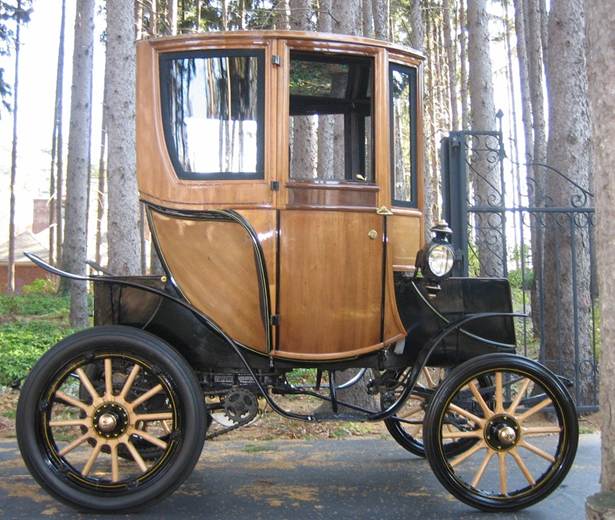
Woods 214a Queen Victoria with Brougham Top
In September of 1908, sales manager Carl J. Metzger with W. S. Peterson drove a stock model 214 Queen Victoria called “Betsy” from Chicago Illinois to Lincoln Nebraska using a standard ESB Exide lead acid battery. They had no spare parts and suffered no breakdowns, demonstrating the reliability of this platform.
In 1909, Louis E. Burr, whose entire career had been with C. P. Kimball, a luxury carriage builder that made some of the fancier custom bodies for Woods, quit his position as secretary, and took over as Woods President.
The new management seems to have attracted fresh capital, as the factory was expanded to 160,000 square feet. Ads claimed 1,500 owners in the Chicago area, more than all other electric makes combined.
Frederick Newman left Woods to start the Chicago Electric Motor Car Co. Roland S. Fend, from Elwell-Parker and C. D. Firestone’s Columbus Buggy Company, became chief engineer.
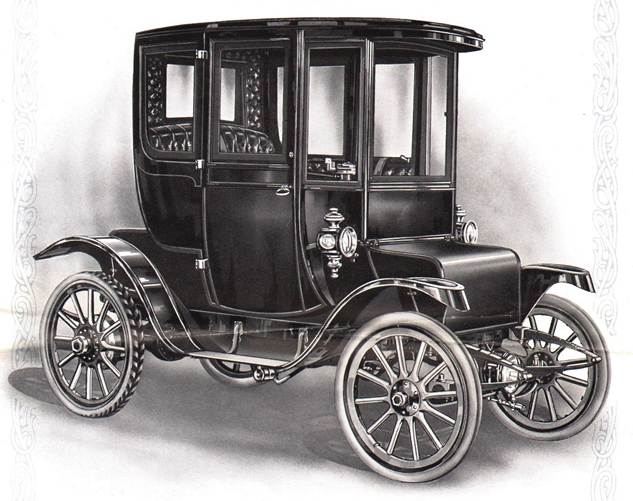
1912 Woods Brougham
In 1912, Woods joined most other makes in offering shaft drive cars, albeit with sub optimal straight-cut bevel gears having a lower reduction ratio than is practical with worm gears. This necessitated reduction gears or chain, usually at the motor end of the driveshaft. Woods stuck with a herringbone gear set. They proudly stayed with suspension designed for cushion tires. As the cars came to use drivelines and chassis formats similar to the other makes, more of the components had to be outsourced. In 1914, six models of Woods electrics covered the range from a light Roadster for the busy businessman to a five-passenger Brougham. In 1915 there were four models, and they adopted a worm-drive rear end, which was quieter and eliminated the need for reduction gearing.
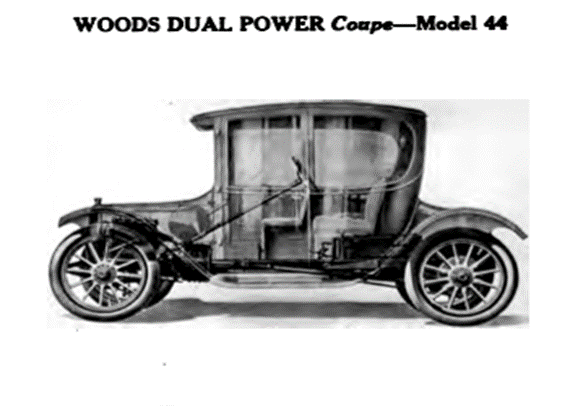
Woods Model 44 – the first Production Gasoline-Electric Parallel-Hybrid
The company’s final act was the Woods Dual Power car, designed by chief engineer Roland S. Fend. Introduced in 1916, and made until late 1918, this was the first production gasoline-electric parallel-hybrid as we know them today. The initial version was called the model 44 Dual Power Coupé. It was a 4-passenger car with a 14 horsepower 4-cylinder le Roi engine, coupled through an electric clutch to a 20 horsepower electric motor. It had a battery with about half the capacity of the typical electric car and could run on either or both motors. When running at speed on the gasoline engine alone, the field windings were shunted and the electric motor became a dynamo, recharging the battery. Regenerative braking was employed when the brake pedal was partially depressed.
This first iteration had an 110” wheelbase and was rated at 20 mph electric only, and 35 mph on both motors. They claimed 48-mpg. The base price was $2,650. At that time a similar model T Ford sedan got about 15-mpg with a base price of $740.
Fend designed an updated version, after which he married, quit Woods, and took his bride on a honeymoon tour of the country in his new Dual Power Coupé.
The updated version was introduced in June of 1917 and called the model 54. It got a larger body, a more powerful Continental engine, and a 124-inch wheelbase. New amenities included an adjustable rain-shield, better lighting, and a rearview mirror that ran across the top of the windshield. It was priced at $2,950.
Woods, as with many car companies, did not make it through the severe disruption of the war economy, which was particularly hard on Chicago, as military contracts went to the East Coast first, while the price and availability of raw materials affected everyone.
Known serial numbers suggest Woods produced about 5,200 vehicles of all types.
The January 23, 1919 issue of Motor Age listed Woods Dual Power as a company that was “definitely and permanently out of business.”
Version 4.7