E. W. M. Bailey, antique electric car, 1908 Bailey Victoria, Amesbury, Bailey Electric car
S. R. Bailey & Co.
For information about Bailey models, please see the A-B webpage
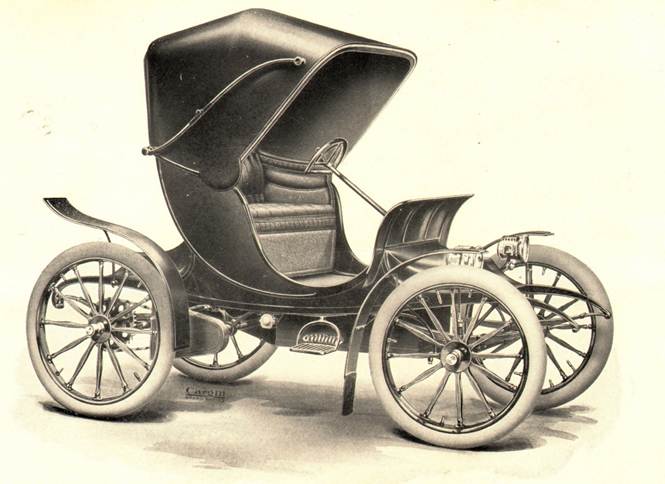
1908 Bailey Victoria Phaëton
Samuel Robinson Bailey was born in the farming community of East Pittston, Maine in 1837. An archetype of Yankee ingenuity, he made his first sleigh in his father’s well-equipped shed while still in his teens. It won best in show at the 1855 carriage exhibition in Portland. Bailey started his first company the following year in an empty church building at East Pittston, producing around twenty units annually. In parts of the snowy Northeast countryside, before paved roads, sleighs could outsell carriages. A foot or two of snow smoothed out the ruts and bumps nicely. In 1868 Bailey moved the works into a larger empty church in nearby Bath, a seaport and shipbuilding town with a population of about 7,000. In this factory of more useful size, with its own smithy, he began to design machine tools. Many of Bailey’s early innovations improved steam wood bending. He started using interchangeable parts, which brought down manufacturing costs and made for fast easy repairs. Bailey redesigned draft horse hitching hardware. His standardized shafts had patented adjustable Bull Dog shackles with improved shaft eyes. Along with his bent-poles, whiffletrees, and yokes; these accessories came to be used by many other carriage and sleigh builders around the country. Bailey designed belt-driven shapers for making the shafts. SR Bailey also invented a method of making wood panels by peeling logs instead of sawing them. He then laminated the thin panels as plywood. Bailey was not the first (apparently Alfred Nobel’s father), but he was very early.
SR then formed a partnership with Wood Brothers in Boston, where Bailey designed his Portland Cutter (a small one-horse sleigh), based on the superior strength of his bentwood frames when compared to those with standard mortise and tenon joints. No one had successfully bent wood 90º before. His version was even better than the popular Portland Cutter that made a reputation for the Kimball brothers a few years earlier.
Bailey became fed up with partners exploiting his innovations. In 1882 he left his high-salaried position with Wood Brothers and moved his sleigh and hitching pole operation to an uncertain independence in Amesbury; a mill town and farming community in the hills near the marsh-flanked mouth of the Merrimack River. Amesbury is located at the extreme Northeast corner of Massachusetts; north of town is out of state. The town lies across the river from Newburyport, which had become a center for building the Clipper Ships used in maritime commerce. Newburyport, on the southern side of the Merrimack, had gently sloping land, which is conducive for docks and shipbuilding factories. Logs were rafted down the Merrimack from abundant forests up river.
Elevation change is necessary for streams vigorous enough to power saw mills. Amesbury was ideal for water-powered mills, as the north bank of the Merrimack had high bluffs with a pair of streams reliably fed by large upland marshes. These wetlands, augmented by a low dam, supplied water year-round with regulated flow. Amesbury had the mills and Newburyport built the ships.
1808 marked the completion of a canal from the up-river town of Lowell to the ample harbor of Boston, allowing logs to be rafted directly there. Lowell is where the Merrimack River powered giant weaving mills, helping kick off the industrial revolution in America. Over the following years shipbuilding moved to Boston.
Amesbury became a center for the construction of horse-drawn vehicles, which required similar woodworking skills and machinery. With the advancement of high-pressure steam technologies in the 1830s, factories were freed from dependency on falling water. The larger buggy companies moved up on “Carriage Hill,” just above the town.
Bailey moved into an old 115×45 foot three-story brick textile mill at 77 Elm Street, with a water wheel powered by Back Creek. As was common in the carriage industry, most Bailey Sleighs were shipped “ready to paint” (in the white) from the factory. This saved on the amount of weather-protected storage space required while paint and varnish dried, along with the labor required for many hand-rubbed coats. Paint drying dominated the top floor space of many great coach building factories before quick drying lacquer was introduced in the mid 1920’s.
The name Bailey came to be known for products that were light yet durable, with the highest quality at a fair price. Bailey added a small line of carriages. His designs were innovative, and he rapidly gained a reputation enhanced by winning many gold and silver medals. Bailey introduced the first glass windshield in 1884, as part of the dasher screen on a sleigh. He was credited by Hub magazine as being the first to put bicycle type (wire-spoked pneumatic tire) wheels on a carriage. SR Bailey was justifiably proud of his products and would not make bodies for other vehicle makers. He did not want other names on his work nor his name on the work of others.
In 1887 SR Bailey formed a partnership with his son, Colonel Edwin Warren Marble Bailey. The following year, a record blizzard collapsed a roof at the Bailey factory, ruining many completed carriages waiting for spring delivery. Less than a month later, a fire started at the F. A. Babcock factory complex up on Carriage Hill, burning its four buildings to the ground. An intense wind was blowing, and the fire spread rapidly, destroying a dozen neighboring factories, a large brick storage facility, and some twenty houses. The town’s postal and telegraph offices were also lost. Due to financial conditions, caused by border and merger disputes between adjacent townships, Amesbury did not have a steam pumper. Because of the lack of roads passible in winter, fire-fighting equipment from nearby towns had to be transported on rail cars. They did not reach the scene until the fire had burned out. Although Amesbury was a hub of horse-drawn carriage making, most product left town by rail.
The Bailey factory was down on Elm Street and not directly affected by the fire. With little remaining storage space, they devoted their energies toward the growing demand for their patented carriage poles, planing to return to vehicle manufacturing later in the season, intending to produce 2,000 units.
F. A. Babcock rebuilt with a large modern carriage factory. The bank, for complex and mysterious reasons, foreclosed on it just as production started. The carriage community seemed to blame Babcock personally for the fire disaster, and he moved to New York. Somewhat ironically, he went into the insurance business, using his flashy and energetic salesmanship to build a thriving agency.
On February 1, 1890, S. R. Bailey & Co moved into the former Babcock factory, leasing two floors amounting to 30,000 square feet of space. They grew to fill the entire facility, eventually purchasing the factory in 1903 for $150,000.
By that time, Frank A. Babcock had gone back into the vehicle business, making electric cars in Buffalo, New York.
S. R. Bailey & Co sent three of their Whalebone Pneumatic (tire) Road Wagons to the 1893 World’s Columbian Exposition in Chicago, as did sixteen other Amesbury buggy builders. One of them was in white, one in clear varnish, and one painted. Bailey won the Gold medal. EWM Bailey attended the Fair as part of a three-week trip with his wife. They are likely to have seen the Morrison electric wagon and the few European motorcars on exhibit there.
Most carriage makers made dozens of different models to appeal to a wide range of customers. These had to be hand made one-at-a-time from measured drawings. Bailey focused on a few perfected designs made with interchangeable parts. Interchangeable parts had been used for crossbow locks (triggers) in China more than 2,000 years before, much later by firearms makers in France, then by New England gun and clock makers. Bailey was one of the first to use the method for vehicles. He combined interchangeable parts with assembly lines; resulting in more efficient production with uniformly high quality. The designs included his Whalebone Road Wagon, Essex Trap, Bicycle Wagon, and a classic Stanhope, as well as his popular sleigh.
In 1896 the first American automobile was produced for public sale. The following year two of them were electric, American and Columbia. In 1898 SR Bailey and his head pattern maker, Walter Baird, made a prototype electric car. It did not run well as it could not handle the weight of the lead-acid battery. Son and partner, Col. EWM Bailey, was mustering for the Spanish American War at an army camp in Chickamauga, Georgia, where he met William G. Bee. It was Bee who gave Thomas Edison a demonstration ride in an 1897 Columbia Electric. After Bee served as a gunner’s mate, during the rapid defeat of Spain, he returned to Albert A. Pope’s Columbia & Electric Vehicle Co, then went to work for Edison at his new battery company. Bee was impressed with the Bailey company’s robust light-weight construction techniques. While negotiating a contract to build battery boxes for Edison, Bee sold the Baileys on Edison’s revolutionary new alkaline battery, which was expected to make electric cars strong competitors against explosion and steam cars.
By 1906, the horse carriage business was fading fast and several coach-builders had introduced electric cars for their upscale clientele. That July SR Bailey made an exception to his rule––he started building bodies and assembling steam cars for the Essex Motor Car Co of Boston––a $3,000 copy of the 1905 Gardner-Serpollet. The enterprise was not a success. Bailey was forced to start leasing out surplus factory space to others, such as the Amesbury Rattan & Reed Co, maker of a rattan auto body.
In December of 1906 S. R. Bailey & Co announced entry into the motorcar business with an electric Victoria. To raise development capital, the Company was incorporated for the first time, issuing $500,000 in common stock and $100,000 in preferred. Father and son retained half of the preferred stock; the rest of the stock was sold at market, most going to Boston investors.
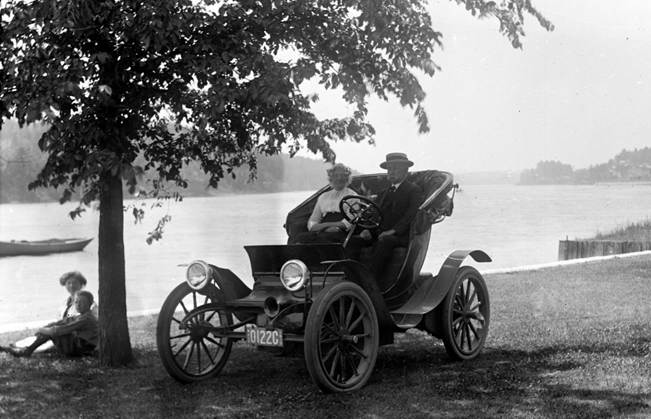
Helen and SR Bailey in a Victoria alongside the Merrimack River
The Victoria body weighed only 30 lbs and featured the same laminated and bent-wood bodies that SR Bailey developed for light sleighs, giving superior strength to weight. Bailey advertising boasted being the first electric “designed for the Edison Battery.” Unfortunately, the car was ready for production three years before the “perfected” Edison Battery, and they were forced to ship the early cars with lead-acid batteries. Edison put his first battery on the market in 1903, and withdrew it in disgrace by 1904. The seams developed leaks and the cells lost capacity with use. Edison kept promising and perfecting. SR Bailey made his cars in very small quantities until the Edison Battery was reintroduced in 1910. After spending much of his personal fortune; Edison solved everything but cost and efficiency. Despite advertising claims, Bailey was one of three makes to “officially” use the reintroduced Edison Battery, along with Detroit Electric and Healey. Bailey claimed a 100 to 150 mile range (80-100 at full speed) with the Edison Battery.
1907 saw a sharp recession and marked the last shipment of Bailey Whalebone Road Wagons. If Bailey & Co was to have a future it would be in their electric cars.
Bailey’s original Victoria Phaëton had chassis frame sills that were a composite of angle iron and steel plate, creating a moderately flexible chassis frame. The body’s framing was made of bent-wood––eliminating the need for many joints. Body panels were of curved three-ply wood. The entire car, without battery, weighed 825 lbs. A 30-cell Gould lead-acid battery was housed in a wooden box suspended under the chassis. The 28-Ampere GE motor was under the seat area, mounted on an independent frame, along with the differential/countershaft gears and Morse silent-chain speed reduction assembly. Sprockets at the ends of the jack-shafts drove the rear wheels through twin-chains. A GE type “S” 50-Ampere rotary controller gave four speeds to 18 mph, or slightly faster in the optional high-speed version. Grey & Davis (also of Amesbury) made the light fixtures. These cars originally had tiller steering with a unique D shaped “wheel” that was flat at the bottom. This “wheel” did not rotate, but provided a good grip to move the tiller mast from side to side. A normal wheel-steered version was available, and became standard. The front axle of the Victoria was cast manganese bronze, and the rear axle was chrome steel. All Bailey cars had patented Bailey Pivot Axles, which were SR Bailey’s ultimate sleeve bearing design. All of the car was made at the Bailey factory, except the electrical parts, tires, and chains. The wooden artillery type wheels were made with Bailey’s patented hub, which held the wedge-shaped spoke ends without thru-bolts; the rims were steel. The steering column was hinged for egress, with a control lever at the top of the steering handle. Band brakes were at the rear wheels and on the motor shaft. The standard lead-acid battery had a range of 40-50 miles, but a larger battery with 50% more capacity was available. It was priced at $2,000 with the standard battery. A removable jump seat was $100 extra.
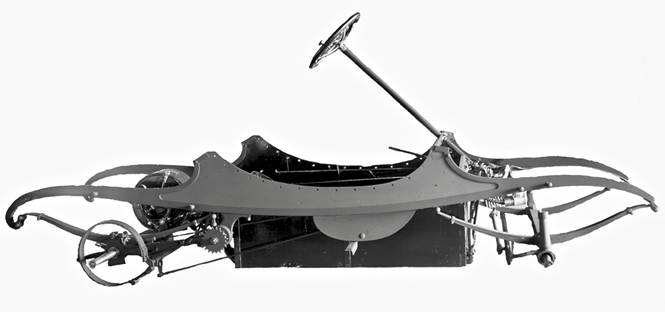
Bailey Victoria Chassis
Late in 1909, Bailey advertised the new Edison Battery equipped Victoria, with a photo of Edison (not known to drive) being chauffeured by Colonel Bailey. The ad claimed their Victoria to be the only car “designed for and using the new Edison Battery, which has recently been brought to a high state of perfection – a battery insuring a run of 100 miles on one charge, and no repair bills.” The Edison Battery Works obtained two Baileys.
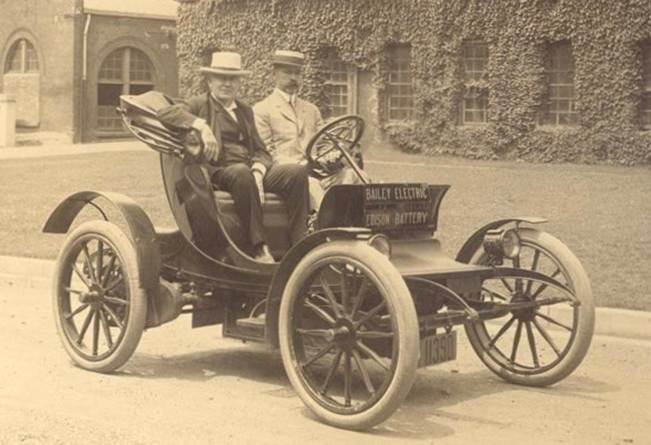
EWM Bailey driving TA Edison c.1910 (Henry Ford Collection)
In September of 1910, the Company Victoria ran a test using the new Edison Battery; from New York to Boston and back, with a side trip up Mt. Washington, almost 1,000 total miles. Not mentioned in Bailey literature (nor visa-versa) a Detroit Electric Victoria ran the same trip with equal success, often alongside the Bailey. The Detroit was also equipped with an Edison Battery and had a similar twin-chain drive. Using the lower speed Elwell-Parker motor, it needed no intermediate speed reduction chain. The 1910 Bailey Victoria cost $2,400-$2,600, depending on size of Edison Battery. The Detroit Victoria, with the bigger battery standard, was also $2,600. Edison chose the Detroit Electric Victoria for his household, replacing it with a new shaft-drive version in 1911.
In November 1911, Bailey introduced the model E Runabout, built to the specifications of the Edison Illuminating Co of Boston, which ordered six cars. A standard E Runabout sat two occupants on a spindle-back seat; there were no doors. With a wheelbase of 104 inches, it had a top speed of 26 mph. The E cars came with a Sangamo Ampere-hour meter (typical for Edison Battery cars) and a separate Voltmeter. With 60 A-4 Edison cells it weighed 2,200 lbs. The battery was under a low sloping front hood that was hinged at the cowling. Price, with top & electric horn, $2,500. The lines looked a bit awkward, and the model did not catch on with the wealthy women who had come to be the principal users of electric cars.
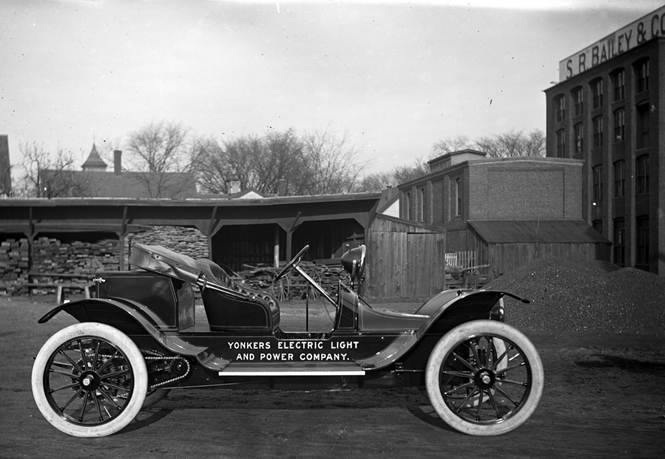
1913 Bailey Model E
Bailey made specialty versions of the model E, including a four-passenger Roadster, others were designed as service vehicles for the electric power companies that were becoming Bailey’s best customers. They liked the fast charging feature of Edison cells.
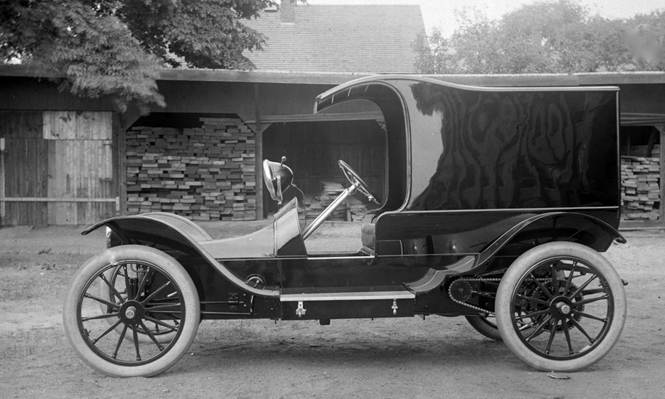
1913 Bailey E with Delivery Body
All models except the Victoria had the model E type of three-point spring suspension at the front––borrowed from the Whalebone Road Wagon. These used a long arched transverse spring at the front, with a shackle at one end to accommodate flexing. The body was hung from the top of the arch with a ball joint, allowing the front wheels to move with greater independence from the body, which would lean into curves a bit. A pair of full elliptic springs was at the rear. These cars had a conventional steering wheel.
Introduced in march of 1913, the model F was mechanically similar to the E. It had a much nicer body, with flowing lines. The F was more fully equipped, with a windshield, doors, comfortable seating, and more storage. They had twin brakes on 12” rear wheel drums, with a 14” drum brake on the counter-shaft. The standard color was English Purple Lake; other colors were available on request at no extra charge. Upholstery was black leather.
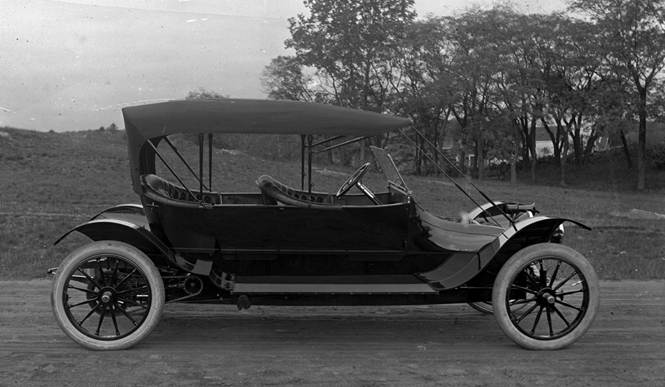
1913 Bailey model F Touring Car
The model F came with 60-A6 Edison cells having a 225 Ah capacity and weighing 1,200 lbs. The GE motor was suspended under the rear hood. The car had an 112” wheelbase, 147” overall length and 65” width, and 12” road clearance, with the center of gravity 18” above road. It weighed 2,700 lbs, and cost $2,900. The model F ran at 20 mph for 75-100 miles, with a top speed of 25 mph.
The S R Bailey factory was sold in October of 1915 to Biddle & Smart, which was building auto bodies on contract. They specialized in bodies for low production luxury cars, with sheet aluminum over wood frames.
In a rented corner of the factory limited production of Bailey poles & whiffletrees continued until July 17, 1916; along with the assembly of a few more electric cars from remaining parts.
SR Bailey died on July 10th, 1917.
These delightful cars had innovative bodies but used conventional drivelines that could be made in-house. Never popular with the general public, they were favored by electric power companies in the northeast. Bailey made open body chain-drive cars that were a bit outdated by 1912. The electrics that sold best had enclosed cabins, and most had low maintenance shaft-drive. Known serial numbers suggest only about 500-600 Bailey electrics were made.
Colonel EWM Bailey went on to invent the rubber-backed-fabric lined metal channels that became standard for rollup glass windows. In 1920 he started the Bailey Manufacturing Co to produce them.
Version 3.6 Most photos courtesy of Bart Bailey