Columbia electric car company the electric vehicle company lead cab scheme Albert A. Pope electric car history antique electric car first electric car
Columbia/EVC
The Lead-Cab Scheme
For information about Columbia/EVC models please see the C-D webpage.
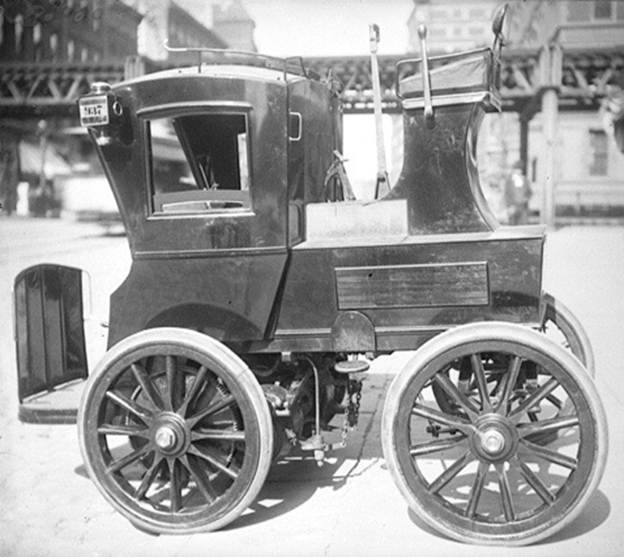
1897 Electric Vehicle Company Hansom Cab
Albert Augustus Pope manufactured small items such as air pistols, cigarette rollers, and tools related to making shoes. In 1876 he visited the Philadelphia Centennial Exposition where he saw displays of British bicycles and recognized their potential. In 1878 he began importing them. They sold well and he started making bicycles domestically within the year. Pope bought or licensed all of the cycle related American patent rights he could, and charged other makers a royalty.
A. A. Pope liked to be at the head of the table; carving a roast for a full-house of people who appreciated his patronage. Although at least six members of his family, including his father, worked for his companies, it did not mean they were advanced beyond their ability. Most of his top managers were not related. Pope was very good at identifying and developing talent.
A. A. Pope commissioned the Weed Sewing Machine Co, located in the old Sharps rifle factory, to make a copy of the most popular British “Penny Farthing” (high-wheel) model, and soon bought the Weed Company. Pope Manufacturing grew into the world’s largest bicycle maker––until surpassed by the Western Wheel Works of Chicago around 1896. By then, there were signs that the bicycle craze was nearing a peak, with slowing sales growth and fierce competition, which destroyed profit margins.
Pope was looking for the next great consumer product and turned to motor vehicles. Gear-heads around the Midwest and Northeast were mounting motors on tricycles and farm wagons with limited success, and a few Benz automobiles were being imported from Germany.
The Pope Manufacturing Company offices were in Boston Massachusetts. The bicycle manufacturing business was in Hartford Connecticut, 100 miles to the southwest.
Lt. Hayden H. Eames, a Pope Manufacturing Company vice president, knew Hiram Percy Maxim, son of recoil-operated (Vickers) machine gun inventor Sir Hiram Stevens Maxim, from Eames work as a military munitions inspector. Maxim visited him at Pope’s Hartford factory, and talked up his experiments with a three-cylinder two-stroke gasoline engine. Maxim’s project caught the attention of Pope’s right-hand-man, George H. Day, who came up through Weed Co management. Day sent metallurgist Henry Souther, who graduated from MIT a year after Maxim, to evaluate Maxim’s attempt to motorize a Columbia tricycle, and he was suitably impressed. Day then hired Maxim as chief engineer of a new motorcar division, under the supervision of Eames. Maxim became Eames’s brother-in-law in 1898 when he married the other daughter of Joseph Hamilton, a former Governor of Maryland.
In 1895 Pope built a new Hartford factory to make seamless steel tubes by a modern process––for everything from bicycle frames to steam boilers. Maxim and his compatriots moved into the first floor of the old steel tube factory––a 50’ by 266’ three-story building standing near the corner of Park & Laurel streets. Production of Pope’s inexpensive World brand typewriter continued on the second floor for awhile. They got a gasoline prototype running, barely, by mounting Maxim’s engine on a light horse-cart.
The cart had many problems. Maxim did not consider it ready for the 1895 Thanksgiving Day race in Chicago. He and Albert Pope did attend the chilly event, and examined the workable designs for motorcars at that point. In most cases the owners were happy to share what they had learned, an exception being the Duryea brothers, who were rather secretive and kept their vehicle under cover in a private garage. During the actual race, won by Duryea, Maxim rode as an umpire on Morris and Salom’s Electrobat II. Although only making a demonstration run, along about 20% of the course, they were awarded the gold medal for “Best Motocycle.” Back then, “Car” usually meant streetcar, “automobile” came a bit later.
On the train ride back to Hartford, Maxim did a lot of thinking about what he had experienced in Chicago. He decided the electric vehicle, favored by Eames and Day as a stopgap technology until explosion engines were tamed, “was not half bad.” Maxim set to work building an electric runabout. This prototype was called the Mk I. After many modifications, mostly to survive the shock of bumpy roads, it was demonstrated to the executives as a proof of concept, as it was very limited in speed and range.
He worked on the prototypes with his assistant, Herbert W. Alden, a mechanical engineer with whom Maxim worked at American Projectile, and machinist Eugene Lobdell. Henry Souther would wander over from the new tube works to lend a hand. Electrical advice came from their battery (ESB) and motor (Eddy) suppliers. The early vehicles had frames made of the 10% nickel steel-tube developed by Souther for Columbia bicycles.
Maxim suffered a second gasoline-powered failure with the prototype Mk II. Just as Maxim was wondering if his career was in jeopardy, he was called to A. A. Pope’s Boston office. Pope had been trying to imagine who would buy a $2,000 motor vehicle in a world where a good horse and wagon cost $700. Pope came up with the idea of a gasoline tricycle for package delivery. Maxim was glad to have a new project, and plans for the Mk III, IV, V, & VI were put on the shelf. Maxim’s team produced the Mk VII, a long-frame gasoline powered tricycle with racks on both sides, and a top speed of ten-mph. This was the first motor vehicle that Columbia offered for sale to the public. The delivery tricycle was “built in quantity.”
The first Columbia Mk III Electric Phaëton prototype was finished late in 1896 and put through its paces. This car met expectations, and it was introduced to press and public on May 13, of 1897, with an initial production run of ten units.
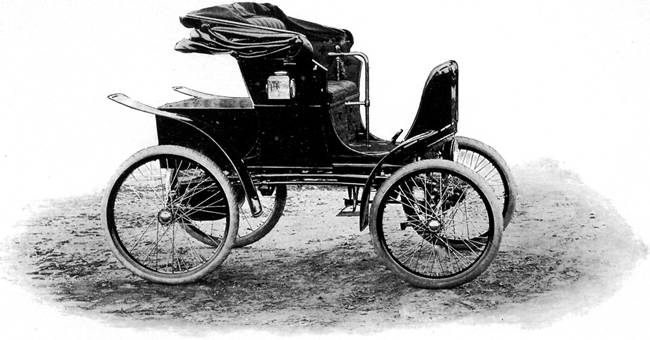
1897 Columbia Mk III Electric Runabout
Although the American Electric Vehicle Co of Chicago had five prototypes on the streets beginning that April, they did not go into full production*, making Columbia the first commercially viable electric motor vehicle offered to the public. Some 500 electric and possibly 40 gasoline vehicles were made with the Columbia brand for the Pope manufacturing empire before the Electric Vehicle Co took over. William Hooker Atwood designed most of the bodies, which were built at his New Haven Carriage Co. Atwood was known for circling the globe; selling luxury carriages, and inspecting what the rest of the world was doing. Columbia introduced a two-motor electric surrey, dubbed the Mk IV, late in the year.
In 1898 the line was expanded to include the company’s first successful gasoline car, called the Mk VIII, and a light electric delivery van called the Mk XI. These “Mark” designations, adopted from Eames’ Naval days, were for the platforms rather than the body style.
Justice B. Entz was the chief electrical engineer at the Electric Storage Battery Company (ESB) in Philadelphia, Columbia’s battery supplier. He talked them into building a prototype of his design, which was a gasoline car using an electro-magnetic transmission. Maxim unintentionally destroyed this remarkable vehicle on its test run. This design eventually became the Owen Magnetic.
The great transportation revolution of the late 1800s was the streetcar. By 1900 most of these were electric, and an electric taxicab business was thought to be a logical extension of the streetcar enterprises.
In 1899, the story of Columbia motorcars was overwhelmed by powerful robber barons from Philadelphia (Widener-Elkins-Dolan) and New York (Whitney-Ryan-Brady) who were creating electric rail transportation monopolies in the cities, hoping to rival the success of big railroads with their steam driven cross-country commerce. They started by rolling up the many diverse horse-car lines and converting them into inter-related electric and/or cable car lines. They then moved to dominate the taxi and livery business with electric vehicles.
Isaac L. Rice was president of the Electric Storage Battery Company when Henry Morris and Pedro Salom started a small electric cab company on Manhattan Island with a dozen Hansom cabs based on their Electrobat II design. Rice and ESB co-founder William W. Gibbs were their principal backers. Rice saw an opportunity. He bought control of the nascent cab company on September 27, 1897, renaming it the Electric Vehicle Company (EVC). He then replaced the fragile rolling stock with 14 more-robust versions, adding an additional 87 vehicles a bit later.
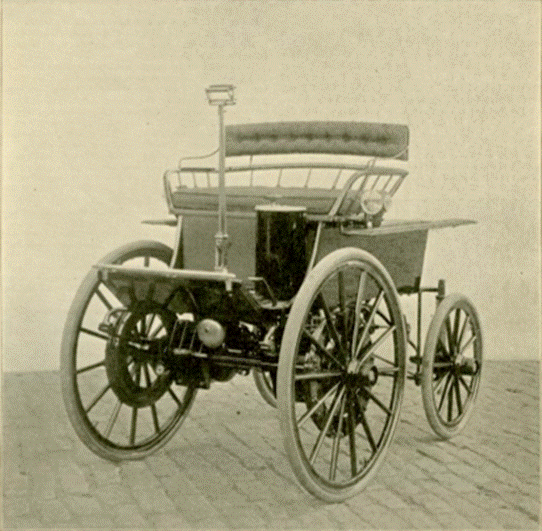
1895 Electrobat II, which beat several 3rd generation gasoline Duryeas in five-mile sprints
The Electrobat II design was unusual in that it had front driving wheels with rear wheel steering. A motor at each front wheel drove them by means of spur-gears on the motor shafts, which were engaged with a large internal-toothed ring gear on each wheel. The smaller trailing rear wheels pivoted for steering, with coil springs taking up road shock. Rear-wheel steering made it tricky to pull away from a curb when parallel parked, a distinct disadvantage for a taxi. Before the introduction of dampers (shock absorbers) coil springs were rather bouncy. The leaf springs used at the car’s front end had some inherent damping due to friction between the leaves.
In 1898, New York transit mogul William C. Whitney bought $1,092,747 in Electric Storage Battery shares, gaining a controlling interest. He then moved to take over the New York lead cab enterprise. Whitney assumed he could get it at a low price, since ESB had a practical monopoly on the best battery and the cab company depended on them for operation. Isaac Rice was a chess master and former railroad attorney who got rich flipping distressed railroad assets. Rice had out-played Whitney. As both president of ESB and owner of the EVC, Rice wrote a sweetheart contract stipulating that ESB was obligated to provide the EVC with batteries at cost, plus a small margin. This forced Whitney to give Rice a generous tranche of ESB stock for his little cab company. ESB was raised from a capitalization of $8,500,000 to $13,000,000 for the purchase of $1,940,000 in EVC stock and to retire $450,000 in bonded debt.
The cab operation had outgrown its location in a former skating rink and moved to the old armory building at 1684 Broadway. Columbia’s electrical engineer, George H. Condict, set up a system of hydraulic lifts and interchangeable battery boxes. When a cab battery got low, the taxi would simply drive into the station and get a hot battery. Several batteries could be on charge while the cab was out working.
Rice stayed on as president a while longer, then sold his ESB stake to buy the electric ship building and submarine companies that would become General Dynamics.
In February of 1899 the Electric Vehicle Co made the Manhattan cab enterprise into one of several regional operating companies. The Electric Storage Battery Co held a controlling interest in the EVC, and the EVC held a controlling interest in each regional operating company.
Whitney wanted to expand operations into all major cities, especially where he and his cronies, several of whom made their fortunes in fossil fuels, owned streetcar monopolies. The EVC had no manufacturing facilities, so Whitney proposed a merger between the motor vehicle branch of the Pope Manufacturing Company and the EVC. This new entity was formed on April 19th, 1899 and was called the Columbia Automobile Co, owned 50/50 by Pope and the Electric Vehicle Co. ESB then came up with a scheme where they licensed their battery to the Columbia Automobile Co for cost plus 30%. For this “right” ESB charged $250,000 in cash and $1,000,000 in stock, representing a third of the EVC’s outstanding shares. Thru this little stock manipulation ESB kept their dominant ownership position in the EVC while returning much of the original capital to the ESB.
Whitney asked the Pope executives whether their vehicles were free of conflict from outstanding patents. Pope’s patent expert Herman Cuntz brought George Selden’s rather broad combustion-engine driven motor vehicle patent to their attention, since it could affect production of their gasoline vehicles.
Although fond of market dominance and collecting royalties, Pope was a product-oriented manufacturer. He worked from the basic model of offering the best product for the price. The streetcar folks were speculators. Whitney and Ryan kept close to powerful politicians. They made money by gaming the system, using the leverage of exclusive franchises, patents, and monopolies of scale, to dominate market sectors.
On May 3rd of 1899 the Columbia & Electric Vehicle Company was formed. The directors had the new company buy $600,000 in Columbia Automobile Co stock and transfer $300,000 in property at a price of $500,000. They then sold 19,400 shares of Company-held EVC preferred stock to ESB at the par value of $100, while the shares were selling at $125 on the open market. An additional 20,000 shares were sold to a group of ESB directors. According to later allegations in a minority EVC stockholder’s lawsuit––these activities caused a loss of a million dollars to the EVC while enriching the ESB and syndicate members by $500,000.
On May 4th the EVC issued new shares used to merge the Columbia & Electric Vehicle Co with the EVC, and to buy Siemens & Halske of America, with the idea of using its huge factory complex in the Chicago area to make the thousands of cabs they thought would be needed. Most of the Siemens & Halske Company (North America) was owned by members of the Widener-Elkins syndicate at that time, through their ownership of the Pennsylvania Iron Works, which had acquired most of the S & H Company’s stock only two years earlier. This paid off more ESB insiders at the expense of the EVC.
Pope used his equity in the bicycle companies and related businesses to become part of the American Bicycle Company. Founded by Albert Goodwill Spalding, whose sporting goods business included a cycle company. This trust brought together 45 companies with 56 factories. Having a small share of a profitable enterprise was better than being sole owner of one that was losing money. Within a few years only two of the best factories were making all of their popular cycle brands.
Albert A. Pope was not the junior partner type. He had been the head of an empire, as one of the world’s largest bicycle manufacturers, with many sidelines, and a growing business in motorcars. Suddenly, he was one of many sharks, some even more powerful than he, in two different holding companies. The stock manipulation had become apparent, and Pope wanted out.
On June 9th 1899, the EVC issued six million in new stock. Five million was used to cash out Pope and to buy Columbia’s main body supplier, the New Haven Carriage Co.
Pope used this capital to buy out some of the 46 other members he had joined in the American Bicycle trust that were not willing to trade their shares to own one of the many factories or ancillary manufacturing companies in the large basket of holdings. They were allowed to make anything other than bicycles, and several made motorcars. Pope kept Indianapolis Bicycle, which was building a strong business with their Waverley Electric vehicles, along with several other companies that were moving into steam and gasoline automobiles, as well as continuing bicycle production. Waverley made the curved-dash-Olds of electric runabouts, and took an early sales lead. A few of Popes gasoline car brands did OK, the Toledo steamer; not so much.
On November 4, 1899 George Selden signed a patent license contract whereby the EVC paid him $10,000 upfront, together with a share of the royalties. This was about $350k in 2025 dollars.
That December, still anticipating a need for greater manufacturing facilities, the EVC bought the Riker Electric Vehicle Co, with another new issue of EVC stock. Andrew Riker and some of his people came along with his eponymous company. Riker was made third vice president of the EVC, and assumed he was the new chief engineer. The EVC sold some vehicles under the Riker brand in 1901 and in early 1902.
Eames and Maxim were coalition builders who formed harmonious teams of talented people. They weren’t able to work with Riker, and quit in 1901. Riker was a prima donna who considered himself inventor of the motorcar. Maxim knew several people with even better claims to that title.
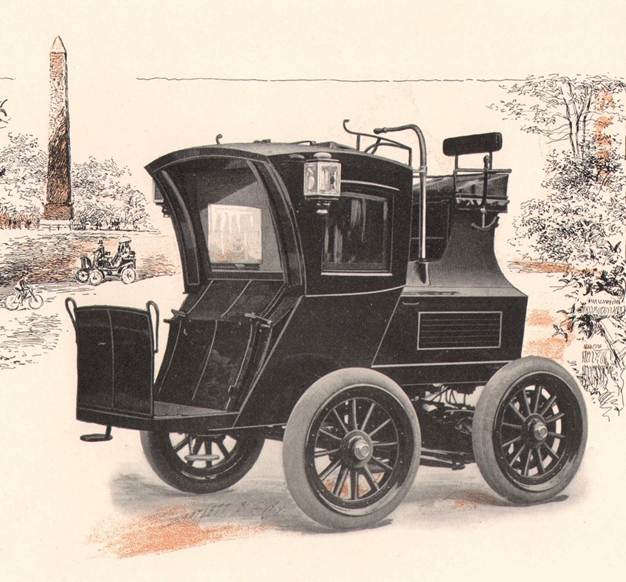
1900 Mk XVII cab on a Columbia chassis driven by the rear wheels, some had a Studebaker body.
In July of 1900, EVC president Isaac Rice, whose equity was now in ESB stock, announced to the press that he was putting in an order for 4,200 electric cabs valued at $8,000,000. He was overly optimistic, and a third of that number was closer to actual production. The New York Transportation Co, the largest operating company by far, was only running 616 cabs and coaches at the end of 1902.
The regional operating companies were grossly over capitalized, at $25 million each, and highly speculative. In a pay dispute, drivers for the Illinois Electric Vehicle Transportation Company of Chicago, with 109 EVC vehicles, went out on strike March 2, 1901. For executives of the marginally profitable company, this was the last straw. The Lead Cab’s economic model was failing. Blaming Chicago’s bad roads, the Illinois operator, headed by Samuel Insull of Commonwealth Edison, gave up the business with a cash loss of $128,000. By year’s end the majority of operating companies had shut down, with several continuing as dealers for Columbia vehicles. Robert Todd Lincoln, Abe Lincoln’s surviving son, was one of the Illinois Company’s directors.
The manipulation of Electric Vehicle Company stock, in which some of the wealthiest financiers in America participated, did great injury to the reputation of electric vehicles. Most historians stress fraud as a principal cause of failure for the lead cab companies. This does not explain the failure of similar enterprises in Europe and North America where the money lost belonged to the initial investors. Limitations caused by the weight, bulk and low energy storage capacity of lead batteries was the main cause of failure. The original Manhattan based EVC cab company was the most successful electric cab operator. It was later investors who bought secondary stock offerings that lost most of their money; the early ESB investors had a much lower cost basis, and several held their stock to the end.
In 1901 Columbia won two Gold Medals at the Pan-American Exposition in Buffalo, New York; the only gold medals awarded to electric vehicles. President McKinley was shot at the Exposition on September 6, 1901. A road race to the Exposition, in which Andrew Riker had been participating in a gasoline car, was called off. President McKinley was taken to the Exposition hospital in a Riker Electric ambulance provided by the Manhattan branch of the EVC.
With the closing of most regional operating companies, it was clear that the EVC factories in Hartford and New Haven had sufficient capacity to fill future orders for all private Columbia vehicles and replacements for remaining cabs. The 30-acre former Siemens & Halske complex near Chicago was sold to GE on April 3rd 1900, at a one million dollar loss. Late in 1901, Riker’s former Elizabethport factory was shut down.
In December of 1901, the New York Electric Vehicle Transportation Co, was reorganized as the New York Transportation Co. Capitalization was cut fivefold to a more realistic level.
Riker left the EVC on January 1st of 1902 to became chief engineer at Locomobile, where he designed some formidable gasoline cars. The Riker brand was dropped by the EVC after 1902. Herbert W. Alden, who persisted during Riker’s regime, became chief engineer.
The paper value of the operating companies had collapsed, and the EVC emerged as a much smaller company involved in the manufacture and sale of electric and petroleum powered vehicles, harvesting royalties from the Selden patent, with some residual cab and livery operations, primarily the original New York system. The sharks from New York and Philadelphia still held a controlling interest in EVC stock and a third of the bonds, mostly leveraged through the ESB Company. They had sales branches in New York, Boston, Chicago, Washington, Philadelphia, London, Paris, and Mexico City.
On March 5, 1903, the EVC, which had filed suit against Winton and Packard for a 5% royalty on the Selden patent, worked out a compromise with the heads of Packard and Olds, forming the Association of Licensed Automobile Manufacturers (ALAM), to enforce the Selden patent at a more reasonable 1¼% royalty, with ½% going to the ALAM, and the balance to the EVC & Selden. This modest royalty helped keep the EVC afloat following the cab disaster. Ford, who had ruffled the feathers of many other manufacturers, was denied a license, causing a protracted legal battle.
In June of 1903 Hiram P. Maxim returned to the EVC from Westinghouse as design head.
On October 21, 1903, a suit was filed by the ALAM against Ford and their agents for violation of the Selden patent. Most manufacturers had signed on and were paying royalties.
That December, Maxim & Alden brought the Columbia light-vehicle drive train up to contemporary standards. The new 1904 Mk LX runabout featured herringbone gear reduction at the motor, which was suspended from the chassis, driving the rear axle assembly at the center by a single Baldwin chain, which decoupled the motor mass from the drive axles. It had 3 speeds forward with two in reverse, and sold for $950 with a full top.
In 1905 More than sixty Columbia platforms were shipped to S. Bianchi in Paris. The Electric Vehicle Company had stronger sales in France and England (under the City & Suburban brand) than any other American electric car company. Bare platforms and untrimmed cars in primer were shipped across the pond, which saved on cost. They were fitted and finished to local tastes.
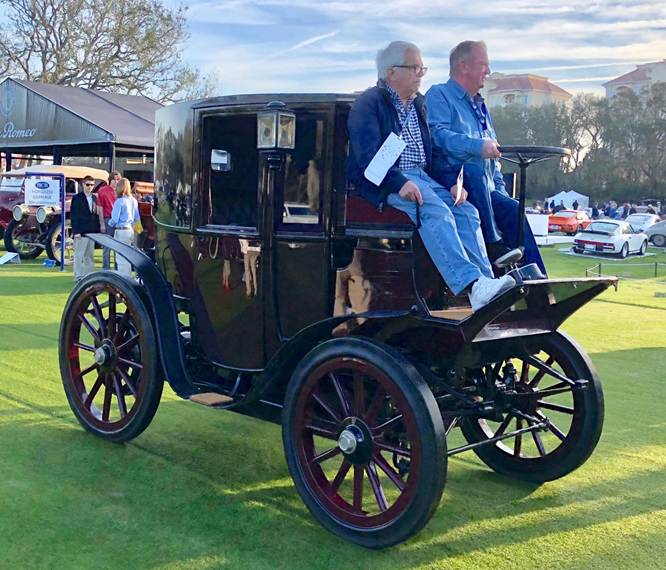
1905 Columbia Mk LXVIII Extension-Front Brougham
Around 1905, Herbert W. Alden went to the Timken companies. He invented some new bearing and axle designs, eventually becoming a vice-president.
In 1907, The New York Transportation Co introduced gasoline taxies, with 50 French Delahaye Landaulets to run in parallel with the electric ones, favoring the longer trips. The last electric cabs were finally retired in 1912.
Maxim left on August 1st, 1907 to start his own electric car company, Maxim-Goodridge. He designed the first electric car to use a worm gear drive, and one of the first with fully floating axles. After building two prototypes they decided to manufacture the gun silencer Maxim invented, inspired by his father’s deafness. In the shadow of the 1907 banking collapse it was nearly impossible to raise the major capital needed to start a new automobile company. Tooling up to make silencers and engine exhaust mufflers required far fewer funds.
The sharp recession of 1907 put the EVC into receivership on December 10th. They continued to make electric and gasoline vehicles under the Columbia brand until 1909. Serial numbers suggest they produced some 6,000 electric and gasoline vehicles, including about two thousand cabs and several hundred light delivery trucks.
The electric pleasure car market was shifting from small open Victorias and large chauffeur driven coupés, with the driver outside in the weather, to cars driven inside the cabin by their owners. Columbia’s model line was out of fashion.
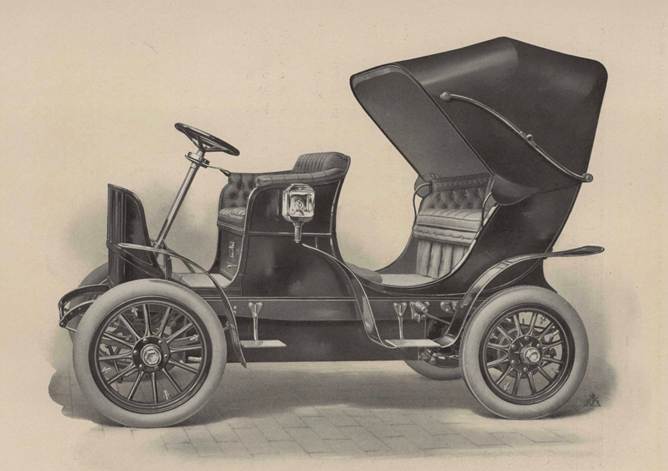
1908 Columbia Open Victoria
By 1908, J. B. Entz had become first vice president of the EVC. They made a few of his costly semi-hybrid magnetic transmission cars. Although they performed well, and were very reliable, business was fading and only ten were produced.
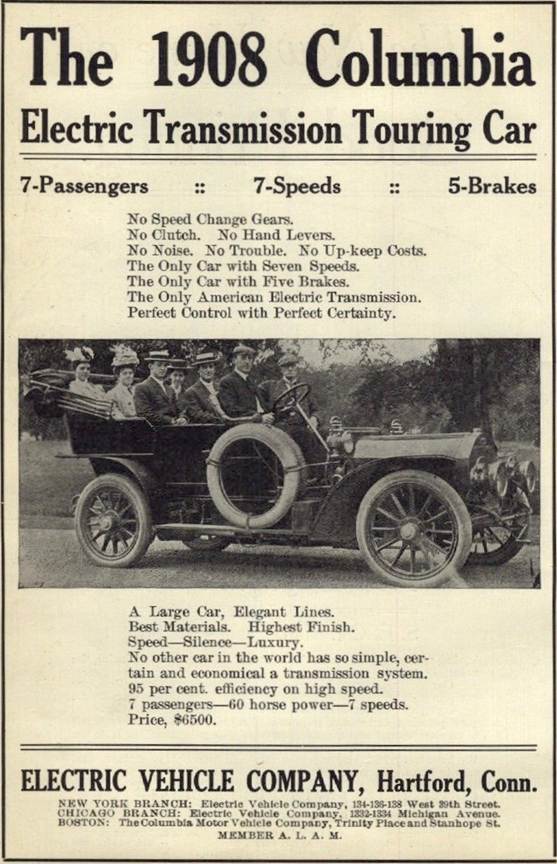
1908 Columbia Advertisement
On June 14, 1909, a judge authorized the EVC to dispose of its assets for $430,000. Holders of common stock would receive a new share for every twenty old shares. Bondholders were entitled to receive preferred stock with a par value of $620 for every $1,000 bond. Principal bond holders were: Anthony M. Brady, Grant B. Schley, Thomas F. Ryan, Harry Payne Whitney, the ESB Co, and the estates of Elkins and P. A. B. Widener; some of the original sharks (W. C. Whitney died 2-2-1904). The largest individual stockholder of the EVC at the time was ESB President Herbert Lloyd.
Both Rice and Pope cashed out before the stock price peaked, the Selden deal was made, and it became an overt fraud.
The New Haven Carriage Co returned to independence, making automobile bodies until 1924, when all steel bodies were becoming preferred.
The Maxwell-Briscoe interests, whose factory had just burned down, picked up most of the remaining Columbia assets. As the United States Motor Co, they continued to sell some Columbia branded electrics through 1910. They failed in 1913, and the Hartford factories were sold on July 1st, 1914 to hand-tool maker Billings & Spencer.
On September 15, 1909 the original Selden patent judgment was against Ford et al, and covered “every modern car driven by any form of petroleum vapor and as yet commercially successful.” Ford appealed, and the ruling was overturned (limited to 2-stroke engines) on January 9, 1911, about a year before the patent expired.
*American seems to have made several more cars in 1898 & 1899, after which the company moved to New York and announced plans for a factory in Hoboken. There was no further mention in the press, other than receivership in 1902.
Version: 5.2