The Milburn Light Electric
Milburn wagon co Milburn electric car Ohio electric car antique electric car history
For information about Milburn models please see the L-O webpage
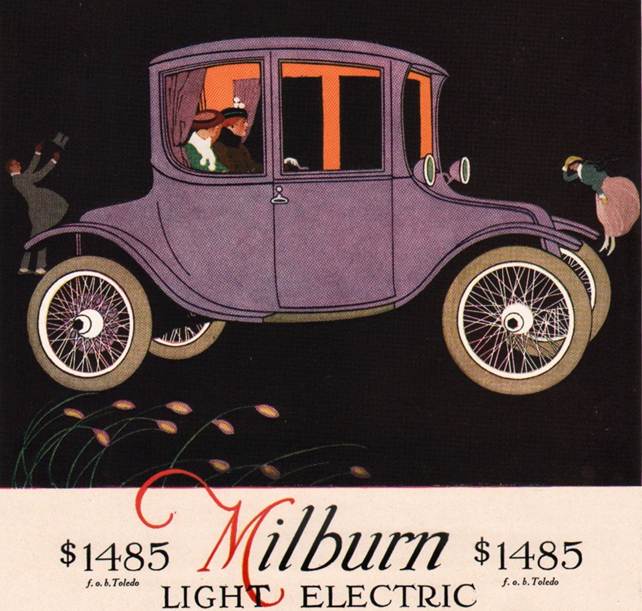
1915-1916 Milburn Model 15 Coupé
The story of the Milburn family and their farm wagon company is fascinating and worth investigating. Merchant George Milburn purchased the original wagon company in 1848. His daughter Ann married Clement Studebaker, tying together the families who built two of the largest wagon companies in North America. The Milburn Wagon Co moved from the small (South Bend adjacent) town of Mishawaka Indiana, to the bustling bayside city of Toledo Ohio for better infrastructure, shipping access, and political support. They also moved from water power to a steam plant. An impressive new Toledo factory was built from 1873 to 1875 on Monroe Street.
The Milburn family had about as much to do with electric cars as Chief Pontiac’s family had to do with gasoline ones. The Milburn family’s equity was eroded by a series of disasters. During construction of their grand state-of-the-art factory a major storm occurred, collapsing much of the unfinished building. Shortly after operation began, a pair of fires required infusions of more capitol, further diluting the Milburn family’s equity stake.
Some of the funding came from Frank Dunlevy
Suydam, principal owner of the Toledo Bending Co, a supplier of wagon
parts. He was the son of an attorney who
owned a successful wagon wheel and carriage company in nearby Lebanon
Ohio. Frank’s father had recently
succumbed to injuries resulting from moving a building, giving him funds to
invest. As the next generation of the
Milburn family lost interest, Frank Suydam, and other affluent Toledo
businessmen, bought them out. The new
owners and directors were often in compatible industries, such as wholesale
lumber and woodworking machinery.
Charles F. Milburn was the youngest son and had the strongest interest
in wagon building. He was the factory
superintendent by 1880, and became company President
in 1888. The Toledo interests eventually
bought out his position and Charles moved to Chattanooga Tennessee, where the Milburn
Wagon Co had an established repository.
Charles went back into the carriage business with W. J. Bass, and built a fine mansion on high ground.
Frank Suydam became the company’s driving force. In 1876 he was elected Secretary, and in 1894 he became President, a position that he held until his death in April of 1911. With his partners and sons, Frank Suydam made Milburn into a very successful wagon and carriage company. When motorcars emerged as an economic force, Milburn started making auto bodies.
Frank’s second son, Horace Suydam, attended the University of Michigan. A fellow electrical engineering graduate, and tennis teammate, was Henry Perkins Dodge. Dodge had the idea of an electric automobile with a solenoid type controller similar to those used in elevators and streetcars. In 1908 Henry Perkins “Perk” Dodge, with his older brother, Frederick Holms Dodge, founded the Ohio Electric Carriage Company to make electric luxury cars. They needed financial partners and a factory. Around February of 1909, Perk looked up his college teammate and made an agreement with his father, this new electric car was to be made at the Milburn factory and called the Ohio Electric.
The Ohio Electric Carriage Company was incorporated that September and capitalized at $75,000; with lumber baron Abram M. Chesbrough as president; Frank Suydam Jr., secretary; and James Brown Bell (husband of Marie Suydam) treasurer. Also on the board were Rathbun Fuller (VP Toledo Railways & Light Co.), Harry E. Marvin (H. P. Dodge’s father-in-law), and footwear wholesaler Robert R. Lee. H. P. Dodge was general manager. Production of the 1910 Ohio model “D” commenced in late 1909.
Ohio and Milburn were considering a merger in the spring of 1911 when Frank Suydam Sr. died suddenly from appendicitis. Horace Suydam, Milburn’s secretary since 1896, became president. He favored simpler lower priced electrics using the Milburn Company’s efficient highly mechanized body assembly techniques which kept Milburn a price point leader in wagons and carriage building long after many such enterprises had failed. Predictably, H. P. Dodge wanted to continue developing his concept for the perfect luxury Coupé, and moved Ohio Electric to a new home a few blocks away on Bancroft Avenue.
At the time of the split, Milburn was making farm wagons, buggies, and bodies for nearby automobile manufacturers Willys-Overland and Pope-Toledo. Around 1911-1912 Milburn was also building delivery truck bodies for the Model T Ford. Detroit was only 60 miles to the North.
Milburn had a market cap of $700,000 with 550-600 employees. The market cap of Ohio had risen to $150,000. Milburn bought the Toledo Bending Co, which was owned by the late F. D. Suydam Sr. and Horace’s younger brother, Henri H. Suydam.
In 1913 Milburn was run by: Horace W. Suydam president; Hiram R. Kelsey vice president; Frank D. Suydam Jr. secretary; and Frank Hafer, treasurer. Also on the board were; A. G. Wright Jr., William I. Grove, William A. Gosline Jr, Thomas Vanstone, and Herbert Baker. Capitalized with $375,000 in preferred stock at 6%, and 325,000 common shares.
In 1914 several of those who left with the Ohio Electric project returned to Milburn, which was gearing up to make the lower priced electric favored by Horace Suydam, who continued as president. Dr. Otto Marx, became the vice president; Frank D. Suydam Jr., continued as secretary; and Frederick H. Dodge, became treasurer. R. S. Woodhull was the sales manager.
George Woodfield designed bodies and manufacturing processes at Milburn. The concept of the Milburn “light Electric” was probably worked out between him and Horace Suydam, who was sitting on an EE degree. Milburn hired light-yet-robust vehicle specialist Karl Probst to designed the platform while George Woodfield designed the bodies––both had distinguished careers before and after Milburn. This lighter less expensive electric Coupé was promoted vigorously and rapidly gained market share, triggering a price war among established brands. The first company slogan was “weighs nearly ton less.” Some of the initial weight and price savings came from using only half the battery voltage that had become standard with the established manufacturers. This weight saving was only 50 lbs. Although using fewer cells, they were heavier, as they used 17-plates per cell rather than the typical 9, thereby giving closer capacity in watt-hours. A bit of of this saving was lost to the thicker wire needed in the motor circuit. Another cost saving added weight. The competing electrics were clad in Aluminum, Milburn chose steel. Reduction in cost and weight also came from hanging both doors from the A pillars with no quarter windows between the doors and the windshield frame. This was a throwback to earlier smaller pre-1912 Coupés. The model 15 weighed 2,100 Lbs.
Another part of the weight saving was in an idea advertised as being found in European car designs of the time. By cantilevering the chrome vanadium front springs, a shorter chassis was achieved for the same wheelbase. This was also used in the 1914 Columbian Electric. Made in Detroit, the Columbian was a similar attempt at a lighter and cheaper electric. This design took weight saving a little too far, as running at an angle into a trolley track or curb could bend the steering linkage, and there was no place to bolt a bumper. The Columbian was noticeably smaller than a typical mid-teens electric coupé, perhaps too small to be taken seriously. The initial Milburn model 15 was about halfway between the Columbian and a typical Coupé, for fifty dollars less than the Columbian.
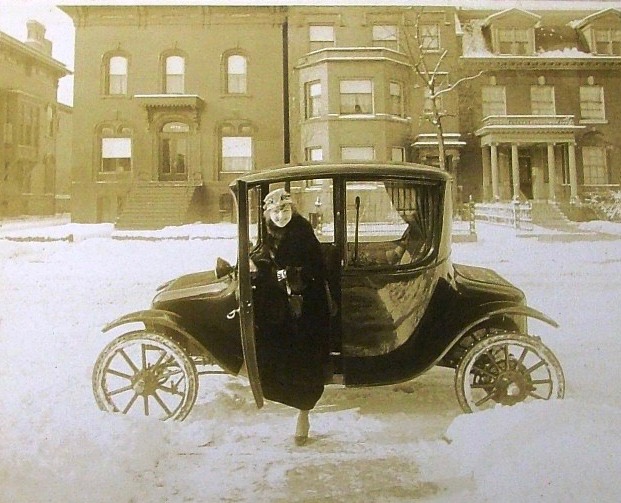
1915
Milburn Model 15 (photo courtesy Myles Twete)
Milburn started with three models, a Coupé, Roadster, and a light delivery truck. Starting with the delivery truck and continuing with the model 22 Brougham, Probst replaced the cantilevered front spring design with standard half-elliptic front springs, hung from extended frame horns. In 1917 Milburn accepted the advantages of the 80-84 Volt battery for their new model 27 Brougham. It weighed 2,900 lbs. and by 1918 it cost $1,885. Not so far in price or pounds from the new Detroit Electric type “B, light-chassis” models ($1,775 at introduction, $2,175 in 1918). $1,775 was the approximate cost of production, it had to go up to recover profitability and cover commodity prices elevated by the war.
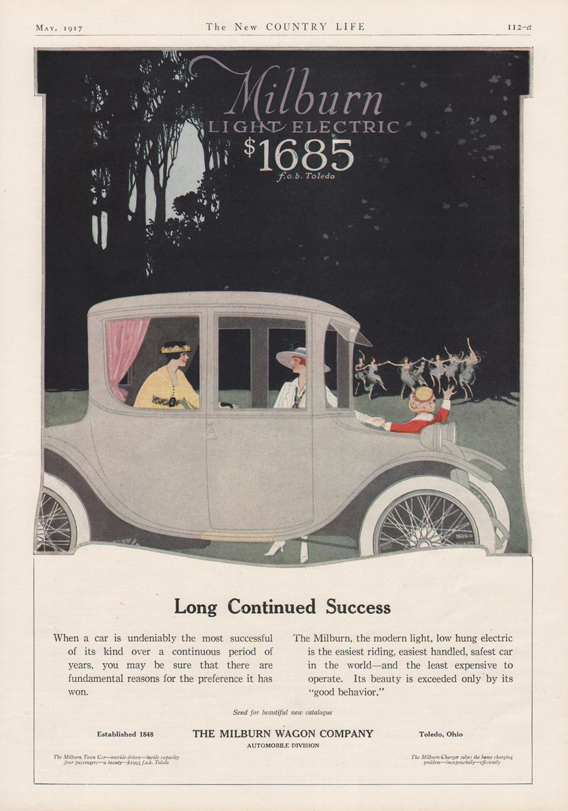
1917
Milburn Model 27 Advertisement
The Timken rear axle used a rather large nickel-steel worm gear driving a relatively small bronze alloy worm wheel, with a ratio of 9.75 to 1. The driveshaft was of one piece with no U-joints, similar to designs introduced by Baker Electric in 1904 and adopted by Ohio Electric in 1910. The steel side panels were welded into one piece, creating a smooth seamless effect. They employed sash-less windows and steel crown fenders. Milburn was one of the first cars with mechanical window lifts in the doors.
Milburn was the last significant manufacturer of electric cars to enter the market in the twentieth century. They used aggressive marketing during their growth period (1916-1917), with more stylish color ads than their competitors, just ahead of Baker or Rauch & Lang. The extravagant color ads took artistic liberties as to color options, although any color could be ordered. Typical Milburns had the panels and hoods in color, with the chassis, window frames, and fenders in black. Originally offered in “Milburn” blue or Brewster green. Colors in the print ad illustrations were often pastel, and included pink, white, burgundy, light blue, grey, and brown.
George H. Woodfield worked at Milburn through the electric car era, and was listed as a body engineer. He is credited with setting up the body tooling and manufacturing processes that made Milburn a leader in the enclosed wood-frame body business, both personal and commercial. Enclosed light delivery bodies became their specialty. While at Milburn Woodfield invented a mechanical window-lifter made by sister company Dura, which was used in all Milburns.
During the later teens Milburn expanded its model range to include some faux radiator sedans, and two types of limousines for taxi service. Neither of these sold very well, and none are known to remain.
According to a company press release, more cars were sold in the first six months of 1919 than total sales for any previous year. Unfortunately, on December 16, 1919, in the middle of the night, the main factory suffered a major fire, said to have caused $800,000 to $1,000,000 damage. The east wing of the original factory, with paint & trim shops, along with the company offices, was destroyed. Quite a few cars were in storage for delivery the next spring; they were moved to safety before the fire reached them.
The end of WWI left many real estate vacancies. Assembly, paint, and trimming moved to a four-story brick and concrete building on the campus of the University of Toledo, built by the government to train Army mechanics. It is much easier to set up a paint and trimming factory than a body building shop, with presses and machine tools. The offices moved to a building downtown, which had been occupied by the Red Cross.
Body manufacturing remained at what remained of the Monroe Street location, delivery bodies and custom work continued at factory number 2 on Summit, the old Toledo Bending plant. In January of 1920, at the New York Auto Show, sales head R. S. Woodhall told the press that because the body factory was not affected, manufacturing had restarted after only ten days, with production expected to be back to full capacity by March of 1920.
In 1919 and 20 Milburn was probably the largest producer of electric pleasure cars in North America, as competition had all but vanished. Detroit Electric, and Rauch & Lang were going through changes of ownership and factory location. Both moved to much smaller factories. Probst remained the chief engineer at Milburn until April of 1923. Later, he consulted on the Jeep design at the American Bantam Car Company.
Throughout its electric car period, Milburn’s main business was as a contract body builder for other automobile companies, specializing in light panel truck bodies, with electric car manufacturing occupying a smaller part of the factory complex, involving about a quarter of the workforce. Detroit Electric battery maker E. T. Stretch visited Milburn. According to him; the electric car part of the Milburn factory was mostly a coach building and assembly plant, as the platform and electrical components were made by outside vendors. The electric car operation had about 200-250 employees.
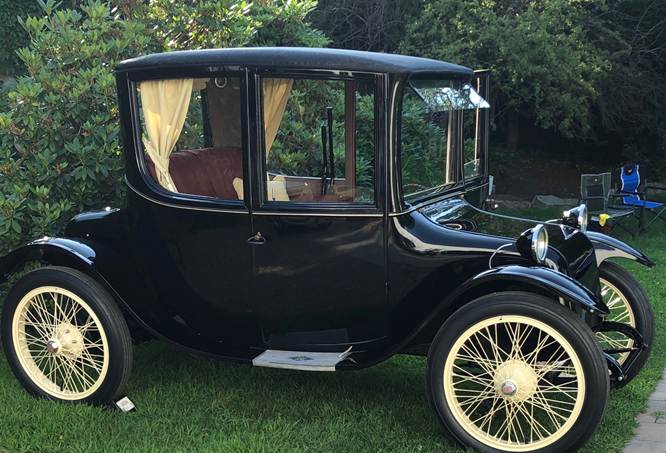
1923 Milburn 27-F, photo ©2023 Bill Lillie
In February 1923, the company’s major assets, including the 20-acre grounds with the coach-works, lumberyard, and mill, were sold to the Buick Manufacturing Co (General Motors) for two million dollars. GM turned around and put the factories up for sale five months later, as capacity at the recently acquired Fisher Body Company plants made the factories redundant. Milburn ran the plants through April to finish current contracts for Oldsmobile Brougham bodies. The last few electric cars from that factory were shipped by May. On July 16th of 1923, Toledo Milburn dealer J. A. Kellam took over control of the remaining electric car and truck company, handling sales and distribution, while H. W. Suydam remained in charge of service. Milburn never returned to strength. They sold cars, trucks, and parts, until they ran out of remaining stock.
Milburn car owners included William H. Seward (son of Lincoln’s secretary of state), Col. Webb C. Hays (son of US president Rutherford B. Hays and co-founder of Union Carbide), Atwater Kent Jr., and football legend Amos Alonzo Stagg. Woodrow Wilson’s Secret Service borrowed a Milburn, as Wilson objected to the sound of a motor running behind his carriage.
The total number sold was around 3,500 units; a figure of 7,000 is sometimes quoted, but is not supported by the known serial numbers. At least 50 of the Broughams remain, a high number compared to other makes, a tribute to its design.
Version 3.3