Edison and the Electric Car
electric car history Edison battery nickel iron cell antique electric automobile
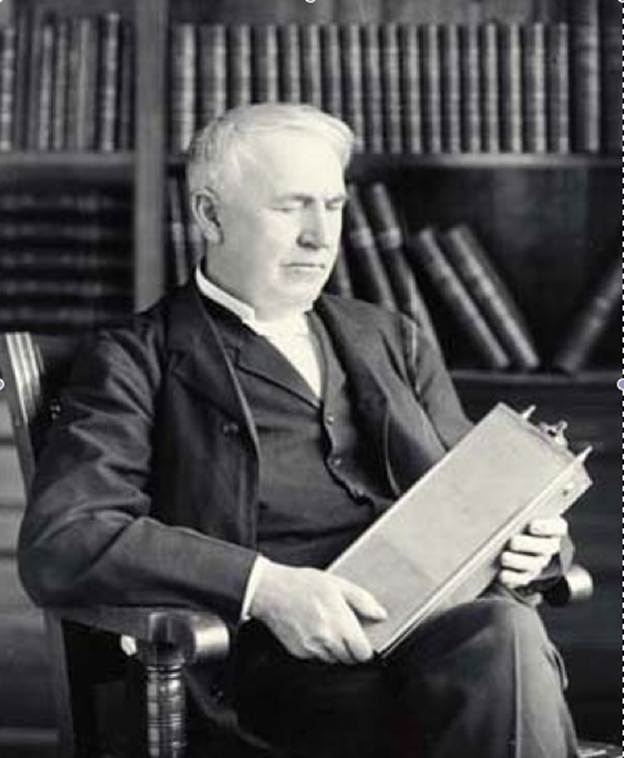
Thomas Alva Edison with His “Perfected” Nickel Iron Cell, Introduced in Late 1909
Thomas Alva Edison (TAE) was not a principal designer nor manufacturer of electric cars, but he and his companies owned many of them and influenced their development.
TAE was an investor in the Lansden Company of Newark, New Jersey, a moderately successful electric truck company that made a runabout for a few years. Edison was involved from the Company’s founding in 1904, and obtained a controlling interest in 1908. The Founder and principal designer, John Lansden Jr, left for General Motor’s truck division in 1911, and Edison sold the company in January of 1912.
Edison had an electric railroad built at his Menlo Park campus in the spring of 1880; eventually running almost three miles from the machine shop to his fishing hole. Although a noted workaholic, Edison loved to fish. Around 1890, Edison had his staff build an electric tricycle, which now resides in the Ford collection.
TAE spent a lot of time shuffling through exhibits at the 1893 World’s Columbian Exposition in Chicago. There he encountered the 1890 Morrison electric wagon, which was part of the American Battery Co exhibit, and likely took a ride. TAE got into an argument over its viability with ABC Vice President Harold Sturges, who was giving demonstrations.
According to Sturges: Edison said, “As it looks at the present, it would seem more likely that horseless carriages will be run by a gasoline or naphtha motor of some kind. It is quite possible, however, that an electric storage battery will be discovered which will prove more economical, but at present the gasoline or naphtha motor looks more promising. It is only a question of a short time when the carriages and trucks in every large city will be run with motors.”
During The 1896 annual meeting of the Edison Illuminating Companies at the Oriental Hotel near Coney Island, New York, Edison repeated similar sentiments to Henry Ford, who was then working as an engineer at Detroit Edison.
TAE spent the next fourteen years and some million and a half dollars of his personal fortune attempting to develop such a battery.
Edison visited the Hartford Pope Manufacturing Co factory in 1897, and got a ride in a Columbia Mk III electric runabout. William G. Bee – who joined the Edison Battery Company in 1903 as sales manager – took him for a spin. He could have obtained one at that time, but Hiram P. Maxim designed it, and Edison was not fond of his father, Sir Hiram Stevens Maxim, one of many he had bitter legal fights with over incandescent light bulb patents. Edison was 53 before he got his first automobile of any type, and did not care to drive. TAE left driving to an employee, son, or his second wife Mina. In late 1900 Edison bought Baker’s first production vehicle. According to Baker’s grandson; the second production Baker runabout made. The first one was kept as the factory car.
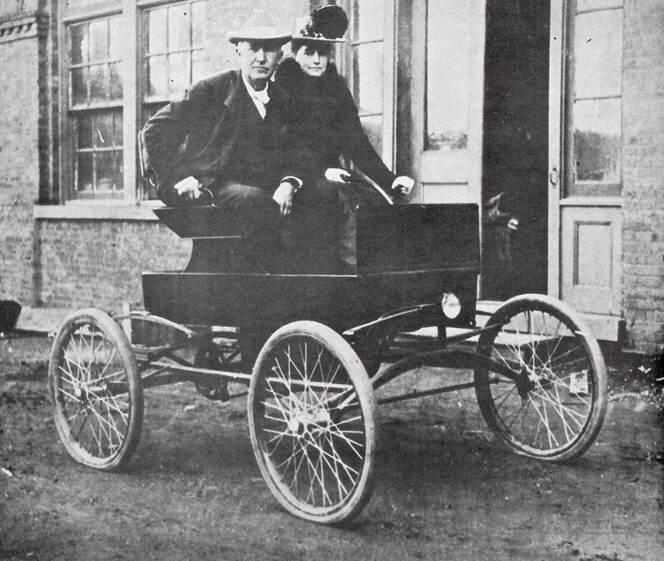
Mina Edison Driving Thomas in Their 1900 Baker Runabout
By the time Edison developed his alkaline battery he was far from a boy genius working in isolation. His first inventions, closely related to his expertise in telegraphy, were improvements in stock tickers. Getting his name in front of every investor on Wall Street was excellent product placement. The amount of available capital led to what might have been his greatest invention, the research and development foundry. Edison was all about taking leading edge scientific discoveries and creating marketable consumer products from them. Rather than create something entirely novel, his role was to “perfect” concepts that were usually thought up by others. Having little formal education, he simply hired the best and brightest graduates from America and Europe. The Edison research and development lab became sort of a post graduate program.
What did it matter that someone made an incandescent light bulb if it burned out in a few hours and required an expensive single use battery. Edison and his staff worked tirelessly to “perfect” not just a lightbulb, but the entire infrastructure to support it. His initial electric light competition was arc lights, which already had infrastructure in place at several larger cities. They were far too bright for domestic use and required maintenance. Home lighting had been by gas light and oil or kerosene lamps. Many cities piped in poisonous coal gas.
Edison developed animosity toward acid-battery cells during his telegraphy career. He spilled battery acid, causing damage to his station, which got him fired.
Production of his Nickel-Iron alkaline battery started very slowly in 1901, with a full week’s output only enough for one car. Manufacturing and design was sorted out well enough to began sales in early 1903, and was running at capacity by early 1904.
Between 1901 and 1904 the battery was tested in several makes of electrics. Edison started with his 1900 Baker runabout. In 1902 he got the second Studebaker Electric sold. A pair of Waverleys belonging to Edison is mentioned in their ads. They apparently went to employees.
The first version of the Edison Battery became an embarrassing failure. The soldered seams leaked, and electrical performance degraded with use. Studebaker introduced an Edison model with longer hoods. They shipped Edison a special order of this 1905 model in August of 1904. Sales of the battery were halted in November of that same year.
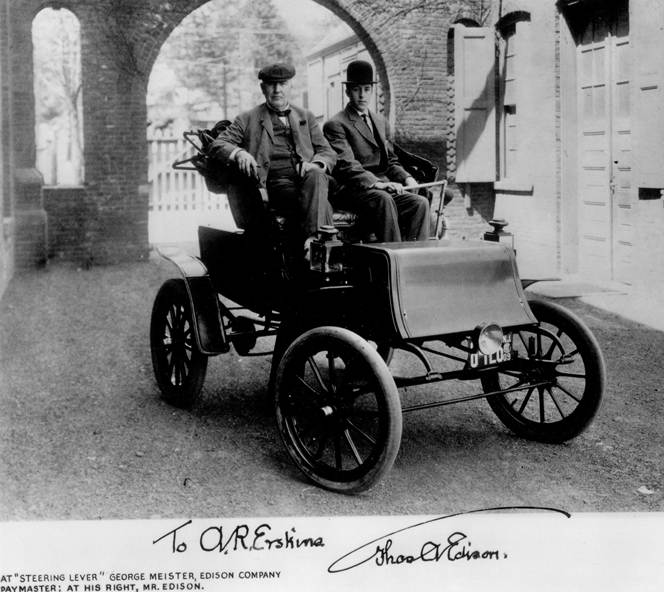
1905 Studebaker Electric, Erskine Joined Studebaker in 1911, VP in 1913
The Edison Battery was not just one invention; it was the product of a few dozen small inventions needed to make the concept live up to most of Edison’s promises.
By 1906 TAE had solved the leakage problem with welded seams that were sealed with high-temperature-bonded nickel plating. He found a temporary solution for the performance problem by alloying the nickel with cobalt. Cobalt was expensive and supplies were limited. After going into the cobalt mining business himself, Edison still found costs were too high to make a profit, so he quietly produced enough of the improved cells to keep Lansden and some electric truck fleet clients happy.
The “perfected” version, introduced at the end of 1909, had completely redesigned positive plates, with nickel flakes tightly packed into nickel-plated steel tubes. It was cobalt free, and capacity increased as much as 30% with use. Edison cells were nearly impervious to both electrical and mechanical insult. They were good enough to return his investment – which was paid off in 1913 – but neither cheap enough, nor efficient enough, to make electric cars competitive with the newer four-cylinder gasoline cars; with electric starters, more balanced engines, and lower prices.
Thomas A. Edison and William C. Anderson, maker of the Detroit Electric Car, both had roots in Port Huron, Michigan. They were acquainted, and it was Anderson who re-introduced Edison to Henry Ford. From 1910 forward the electric cars in Edison’s home garage were all Detroit Electrics. Edison chose Detroit Electric to be the official brand of the reintroduction; along with a pair of low production makes, Bailey and Healey.
All nine models of 1910 Detroit Electrics were available with “Edison hoods” to accommodate an Edison nickel-iron battery set. Although individual Edison cells were similar in size to the standard lead-acid cells of that time, they needed more airflow space between cells for heat dissipation, and only produced an average 1.2 Volts (under load) whereas a lead-acid cell put out an average 1.9 Volts. More cells were required, making them bulkier than a lead-acid battery set of similar voltage. Some makes used the smaller A-4 cells, allowing more to be stuffed under standard hoods, but this lost much of the advantage. The first Edison equipped Detroit Electric shipped to a customer was a model D Coupé, delivered to a Milwaukee coal magnate in late November of 1909. In cars shipped with an Edison Battery, the Weston 240 duplex meter was replaced by a Sangamo Ampere-hour meter. The flatter discharge curve with an Edison Battery made it harder to determine remaining capacity by Voltage alone.
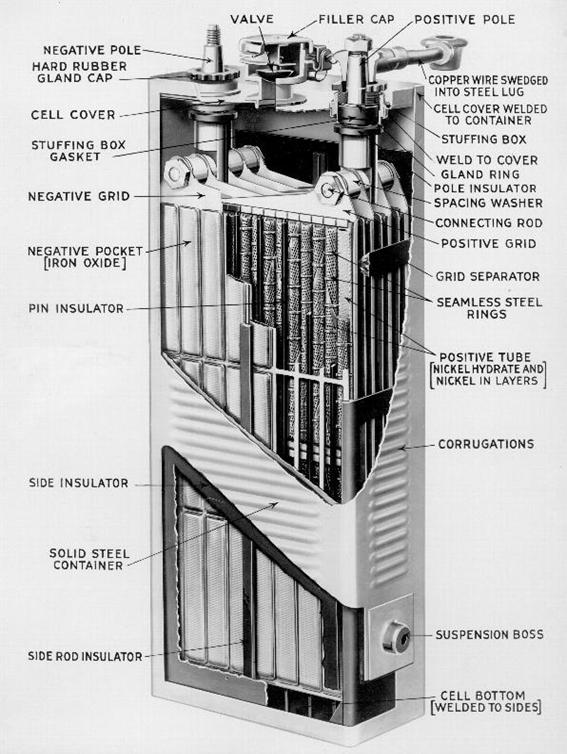
Edison’s Perfected Cell
Colonel E. W. M. Bailey loaned a Bailey Victoria for tests of the perfected Edison Battery. A Bailey and a Detroit Victoria were run up to Maine and back for a thorough demonstration run. Both cars completed the circuit of over a thousand miles with no breakdown.
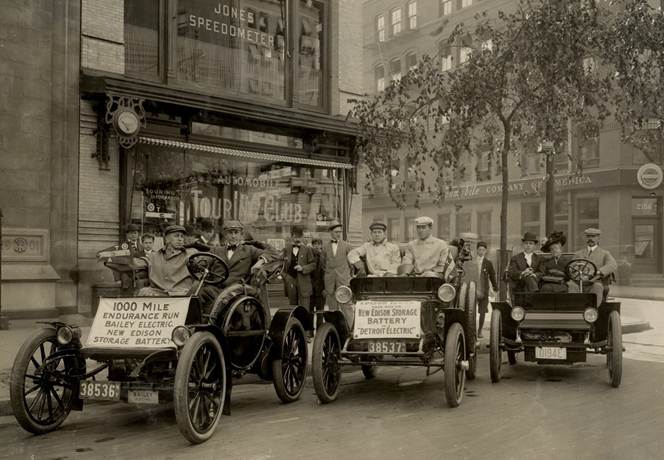
Edison Battery Endurance Run with Bailey and Detroit Electric, In Bridgeport, CT
The Edison Battery required a greater differential between the working voltage and the charging voltage to achieve a full charge, requiring an equalization voltage of 1.7 Volts input for 1.2 out, so the highest practical working Voltage for an Edison battery charged by 110 Volt AC mains through a mercury vapor rectifier was 72 Volts. For a lead-acid battery it was 80-84 Volts. Some makes used lower voltage motors in the Edison Battery cars. Electric cars made before 1912 were usually smaller and ran at a lower voltage to keep the battery smaller and lighter. The 1911 Detroit Electrics ran at 48 Volts, supplied by a 24-cell lead-acid, or 40-cell A-6 Edison battery, which cost an additional $600.
Although they required a higher charging voltage offset than the lead-acid ones, if the charging system used a motor-generator set (AKA rotary converter) or a transformer from AC mains charging voltage didn’t matter much. However, high current transformers and rotary converters were expensive. A charging system that lowered voltage by inserting resistance was cheap at first, but wasted energy and cost more over time. This, and the bigger faster cars with longer range demanded by customers, led most makers to settle on a 40-cell lead battery, or a 60-cell Edison Battery at an additional $800.
It was claimed that the new 225-Ampere Hour A-6 battery would increase in capacity by an additional 30% over time and weighed 50% less than lead-acid batteries of the same capacity or 35% less than the standard 168-Ah lead-acid battery.
“The lead-acid battery would retain about 85% of the charging input whereas an Edison Battery only retained 70% of the potential. An Edison battery under rapid charge also out-gassed more hydrogen and oxygen, so charging required good ventilation.”
(Hay, Secrets of the Submarine, 1917)
On May 23, 1910, Edison wrote to William C. Anderson:
“My dear Anderson:
Your letter of March 23rd received. Just wait two or three weeks. I have taken hold of the business myself. There will be a hot time in the electric vehicle business in the advertising line in the next two months, just watch.
Go ahead and sell all you can and watch the fun coming. That Waverly (sic) Company will set up and take notice.
Under no circumstances must you fail to have that test run vehicle here by the first of June; as I will be ready for it.
Yours very Truly, Thomas A Edison”
A Detroit Electric model A Victoria was shipped to the Edison Storage Battery branch in New York City, May 26, 1910. That early chain-drive model was resold by Anderson the following March, and, in June of 1911, the Edison Storage Battery Company received an all blue Detroit Electric Model 15 Victoria, with the new shaft-drive system. It must have been well received as it was personally registered to Thomas Edison at his estate by 1915, where it still resides. Fred Ott, one of Edison’s long time associates, liked it so much he bought a green one a year later.
On October 14, 1911, Edison wrote to Anderson confirming “exclusive” use of the new battery for pleasure cars in 1912. The letter guaranteed the battery would keep its rated capacity for four years, and suggested that Anderson guarantee it for five, he guaranteed it for 50,000 miles instead. The battery was expensive to manufacture and cost an additional $600-$800 more than a lead-acid battery, depending on the number and capacity of cells. In comparison, a brand new 1913 Model T Ford runabout was $525.
“Exclusive” in a practical sense meant an endorsement, as other makes simply obtained the batteries from wholesalers at a slightly higher price. Perhaps the most important downside of the Edison NiFe cell was that it did not function well below 40º F, yielding only 40% of capacity at 35º F. A lead-acid cell still maintained 54% of its capacity at 0º F. This, and relatively limited maximum current output, made it less desirable as a starting battery for a gasoline car, although the company worked to develop that market. Fleet operators reported that in freezing weather the Edison Battery trucks were slow for the first half hour of operation but perked up as discharge heated the cells. Charging the battery just before a use cycle warmed the cells and helped mitigate the problem.
In 1913, Scottish manufacture Arrol-Johnston built two or three electric vehicles, with a proposed initial production run of fifty. They were built on American made Detroit Electric platforms and used Edison nickel–iron batteries, marketed in Britain by the London based, Edison Accumulators Ltd, the British branch of Edison’s battery business. This is likely to have been arraigned by John F. Monnot, who was both the manager at Edison Accumulators and the European importer of Detroit Electrics. There is evidence that Edison Accumulators Ltd made some delivery vehicles. Thomas Edison was not personally involved in these projects. In 1924 Monnot filed a patent for an improved version of the Edison cell that was sealed, preventing outgassing and protecting the electrolyte from oxidation. It had a small “ignition chamber” to turn the gasses back into water; it did not catch on.
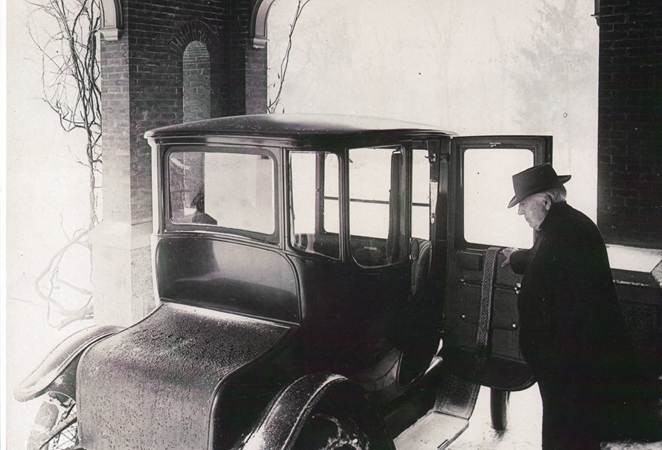
Edison’s Detroit Electric Brougham Was Blue on Blue
In December of 1913 Henry Ford sent the Edisons a 1914 Model 47 Detroit Electric Brougham as a Christmas present. It was delivered to them in New Jersey with an Edison battery, but without a motor (the only car shipped without a motor that I have noticed in the ledgers). Henry also bought the same model for Mrs. Ford, her fourth Detroit Electric in eight years. Anderson hired famed photographer Nathan Lazernick to make portraits of Edison, Ford, and Charles Proteus Steinmetz with their new cars, and featured them in a series of advertisements.
According to a Detroit Electric Car ad in the April 2nd, 1914 Motor World: “Mr. Edison has owned three Detroit Electrics; and these are the only electric cars he has ever owned since we placed our cars on the market” (late 1907). There was also a Lansden truck registered to Edison in 1915.
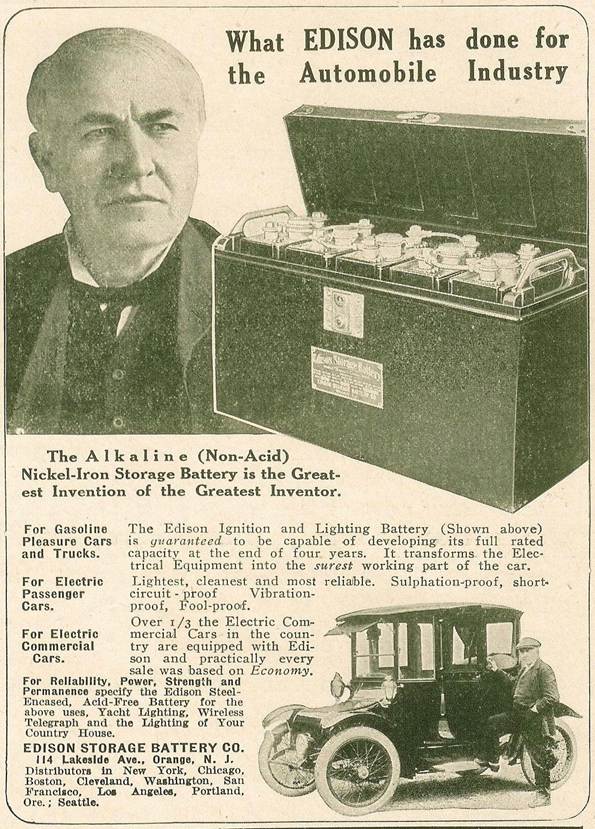
1914 Edison Battery Ad; With A Six-Volt Battery Pack and his Detroit Electric
Edison consulted Edsel Ford on the design of two Ford electric car prototypes in 1914. Ford production techniques could not solve the commodity cost problem.
While working on the Naval Consulting Board in Washington DC, from 1916 to 1919, Edison was apparently chauffeured about in a very fancy 1913 Rauch & Lang TC-3 outside-drive Town Car, possibly gifted by a Maryland dowager. This car also became part of the Ford collection, later sold on.
A 1910 Detroit Electric Model D inside drive Coupé – with two previous owners – was shipped to the battery factory in mid-June of 1914. Many of the Edison companies' executives had electric vehicles, including: five Baileys, several Detroits, a Columbia, and a few Studebakers.
The Edison home stable was not limited to electric vehicles; over the years he also had a matched pair of 1905 White steamers, a 1912 gasoline Simplex, and a 1916 Model T Ford – registered to Theodore Edison.
The Edison Battery had limited success in pleasure cars. The peak year in Detroit Electrics was 1912 when 334 of the cars were thus equipped, compared with 978 in overall sales. In 1913 sales plummeted to 5%, leveling off to 3.9% in 1914. They remained popular in delivery truck fleets through the 1920’s. Edison cells were often the battery of choice where long reliable service was the priority; such as railroad car lighting and warning signals.
Version 4.11