First electric car, Pope-Waverley, Albert Pope, vintage electric car, antique electric car
The Silent Waverley
For information about Waverley models, please see the U-Z webpage.
In 1886 Charles F. Smith moved to Indianapolis from Kentucky and founded the Indiana Bicycle Company as a modest retail store. He soon found partners and went into manufacturing to cash in on the bicycle boom. In 1895 they got a trademark for the Waverley brand, borrowed from the series of popular romantic novels penned by Sir Walter Scott.
Building a factory campus commenced around 1889, and came to an abrupt halt in 1896, as the bicycle boom peaked. By 1897 the Indiana Bicycle Co complex consisted of six major buildings on a full city block. The power plant had automatic underfed coal stokers fueling seven boilers producing 700 horsepower of heat and electricity for the plants. It was a relatively modern factory campus that ran machine tool stations from 24 local pods of shafts, pulleys, and belts, driven by large electric motors. This was a much more efficient power distribution system than the pre-electric-era factories, where a central steam engine, or water wheel, directly powered complex shaft, pulley, and belt systems.
There were machine shops, forges, metal presses, a paint shop, and enameling ovens. The plant turned out bicycles by the train-car load. Almost every part was made at the factory, or by related steel tube and tire companies.
The problem in 1896 was that a dozen other bicycle makers had ramped up mass production, flooding the market and cutting margins to where it was very hard to make any money regardless of volume. It became apparent to many successful bicycle makers that the arena for growth and profits was in the embryonic motor vehicle business.
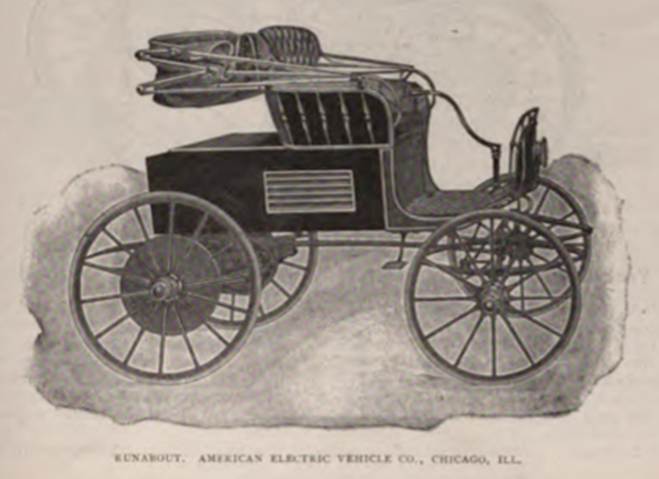
Karsten Knudsen Designed “American” Runabout
The American Electric Vehicle Co of Chicago was one of the first emergent automobile companies. They had a vehicle on the road in April of 1896, the single-motor cars were designed by Karsten Knudsen and the two-motor cars by Clinton E. Woods. The chassis was made by the Elgin Sewing Machine & Bicycle Co, the bodies by the Fischer Equipment Co. American seems to have produced only five bespoke vehicles that first year, as they lacked factory and finance. During that same month, Hiram Percy Maxim was demonstrating a prototype Columbia Electric runabout that he made for bicycle king Albert Augustus Pope.
When American approached Indiana Bicycle about the possibility of manufacturing wire wheels for their cars; Charles F. Smith, Loren S. Dow, and Philip Goetz realized that their Indianapolis factory could easily make entire cars, and proposed a merger. American sent a runabout to Indianapolis for inspection. In May of 1898 they bought a stake in American Electric and began producing similar vehicles under the brand name Waverley Electric. The merger never gelled, but Indiana Bicycle’s management got rights to Knudsen’s designs and patents. Waverley’s version was built under the direction of their former West Coast bicycle distributor, James Simpson Conwell, who was brought from San Francisco in late 1897. A woodworking and coach building factory were equipped, there was plenty of floor space for assembly and letting paint dry.
The Waverley versions had a different chassis, but they used the same Knudsen designed single-motor drive system and steering gear. The motor turned a pair of jackshafts. The motor’s armature was hollow, allowing the longer jackshaft section to pass through it. At the wheel ends of the shafts, straight cut pinion gears drove outside toothed ring gears mounted to the wheel hubs, which spun at the ends of a stationary solid axle. The motor, differential, & jackshafts were all in one housing, which also served as part of the suspension. This kept the pinion gears in alignment with the large ring gears, all moving in tandem with the axle.
The first Waverley Electric sold went to Indianapolis resident Frank Staley in June of 1898. The first motorcar in Los Angeles was a Waverley runabout sold to Steve Hall by Rambler Bicycle dealer W. K. Cowen. He told a reporter at the 1917 Los Angeles Auto Show that he then sold four of the “tallyho” type of Waverleys to Hall; who intended to run a stage line taking tourists from downtown Los Angeles to Lucky Baldwin’s ranch in Arcadia. The rough dirt roads, combined with the high seating position, defeated the concept, as passengers were thrown about with some force.
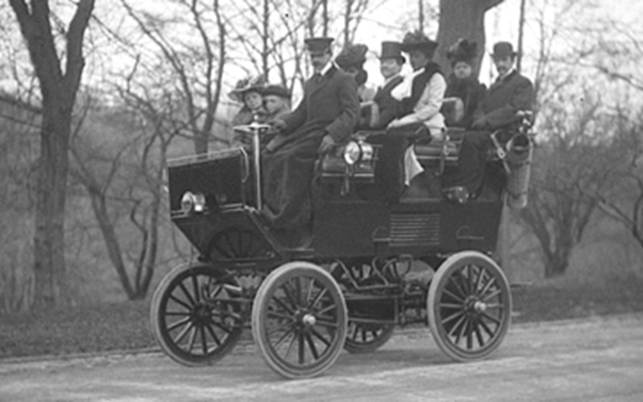
1899 Waverley 9-Passenger “Tally-Ho” Break
In 1899 several prominent bicycle manufacturers, organized by baseball hero and sporting goods magnate Albert Goodwill Spalding, built a coalition attempting to return profitability by closing factories reducing the over-capacity that was destroying profit margins. A smaller share of a profitable enterprise looked mich better than full ownership of a failing one. This trust was called the American Bicycle Co. It had no relation to the American Electric Vehicle Co.
Among the many companies that became part of the trust was the Indiana Bicycle Co. The Company’s investors wanted to take the buyout while the managers wanted to keep making electric cars of the American Electric type. Dow and Goetz resigned to form the National Automobile & Electric Company, where they made their own version.
Executives from some of the 44-47 companies that were part of the holding company’s partnership became the new directors of The Indiana Bicycle Company and the Waverley brand. R. Lindsey Colman from the Western Wheel Works––a nemesis of Albert A. Pope––became the new President.
Parts of the Cleveland Machine Screw Co also became part of the American Bicycle trust. With them came the electric car and battery patents of Elmer A. Sperry. He was hired to consult with the company’s mechanical engineer, Robert H. Hassler, refining his design for production as the new Waverley Electric.
Waverley’s extensive factory campus was re-tooled for making the new electric. It was much lighter weight, lower to the ground, and more efficient. Hassler had the patent for an elegant single motor drive system that eliminated chains and drove the rear wheels from the center of the axle. They used herringbone type gears, which were quiet and self-adjusting. Sperry primarily devoted his time to the design of the electrical system; including his battery, motor, controller, and charging system. Hassler and Sperry did not stay with Waverley for long, and both went on to build their own highly successful companies.
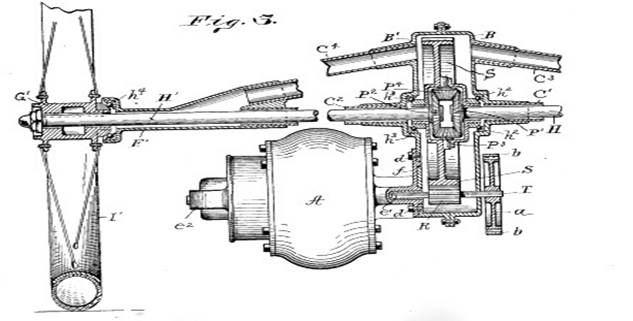
Hassler’s Patent Drawing for the Waverley Drive System
Waverley developed a range of models built on the same light chassis, and a few heavier two-motor models such as a Surrey, Tonneau and Station Wagon, which had an outside driving position with an enclosed passenger cabin.
Their most popular model at the start of the century was a simple and relatively inexpensive open two-occupant style rig generally known as a piano box runabout, which Waverley called a Road Wagon. It was the electric equivalent of a curved dash Olds, and sold very well.
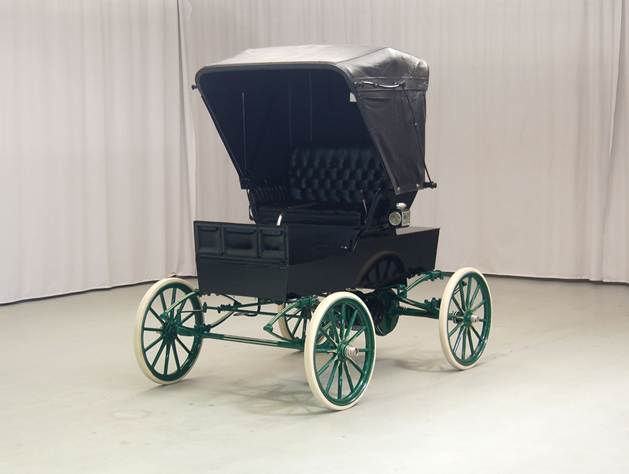
1901-1902 Waverley Model 22 Road Wagon
Albert A. Pope was one of the biggest dogs in the pack holding a stake in the American Bicycle trust. In June of 1900 he sold his interest in the Electric Vehicle Company’s electric taxi scheme, acquired through their recent merger with Pope’s Columbia Vehicle Manufacturing Company. Over the next two years he used some of these funds to buy out other stakeholders in American Bicycle, if the price was right. The trust also sold off many of the assets, including the steel tube and rubber tire companies. Several of the idled factories were traded for equity to parties in the trust, for any use other than bicycle manufacturing. Former bicycle competitors became motor vehicle competitors. A. G. Spalding bailed out early on.
The automobile manufacturing companies, Waverley and the Toledo Steam Car, became the International Motor Car Co. Several of the popular brands of bicycles were continued by another branch called the American Cycle Manufacturing Co.
In September of 1903 all parts went into receivership. The Pope interests, now with the biggest stake, took full control.
Pope was fond of putting his name on things, so both the automobile branch and the bicycle branch were folded into his revived Pope Manufacturing Company. The car’s brand became Pope-Waverley, although Pope had little direct involvement with Waverley vehicles. He might have influenced the addition of hub brakes to the rear wheels in the 1903 models. Waverleys with hub brakes might have been made late in 1902, but they would be considered to be in the 1903 model year by most. Rear hub brakes are first mentioned and illustrated in the 1903 sales brochure.
A. A. Pope removed the American Bicycle management from Waverley and he became the new president, with his son Albert Linder Pope as vice president, and cousin Col. George Pope as secretary/treasurer. The Pope Manufacturing Company, headquartered in Boston Massachusetts, ran many bicycle and automobile manufacturing enterprises in several states. The Waverley Company was “Desk 5.”
Long-time Pope associates, Herbert H. Rice and Wilbur C. Johnson, handled on-site management. They built Pope-Waverley into one of the most important pre-1912 electric car companies, with worldwide sales.
Instead of heavy inside-drive Broughams, Waverley developed a removable Coupé top that would enclose their Chelsea and Stanhope models in foul weather. The Woods Electric of Chicago also used this design strategy around 1906.
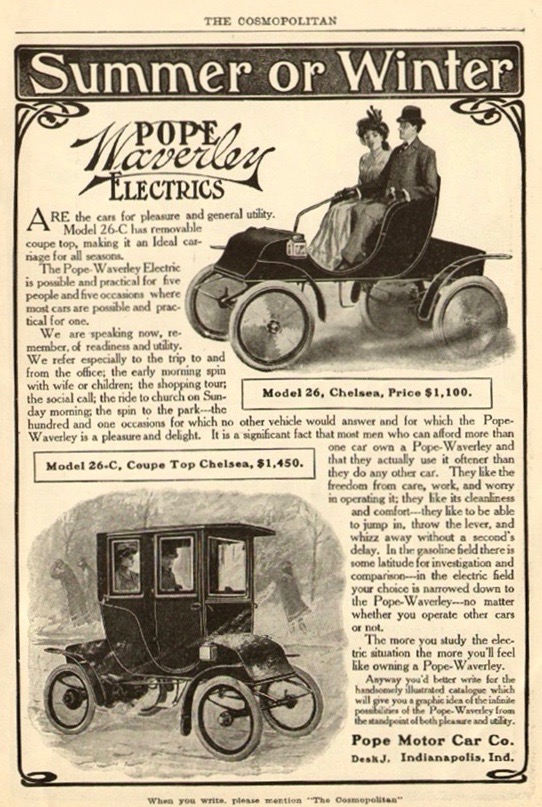
1905 Pope-Waverley Ad
Light delivery trucks were a growing part of production. In 1906 an additional floor, adding about 7,000 square feet, expanded one of the factory buildings. Two floors of that factory were designated for commercial vehicle production.
Although Waverley and some other parts of the Pope holdings were doing well, the bank panic and recession of 1907 was too much for the far flung and over leveraged Pope Manufacturing Company. Albert A. Pope was 64 and in failing health. It became clear they were not able to meet that year’s debt obligations, and bank loans had dried up.
A. A. Pope’s oldest son, Albert Linder Pope, was appointed receiver. He accepted an offer for the Waverley Motor Vehicle enterprise of $200,000, from a coalition of Indianapolis businessmen put together by Rice and Johnson. Pope Manufacturing also retained the company’s cash assets, amounting to $106,420.71, and emblematic of the company’s success. A smaller, restructured, Pope Manufacturing Co remained; making gasoline automobiles, motorcycles, and bicycles through 1915.
Principal investor William B. Cooley became president of “The Waverley Company,” with Rice as vice-president, and Johnson as secretary. Carl von Hake, of the Indiana Coffin Co was treasurer.
The electric pleasure car market around 1910 was shifting from light open cars to inside drive Coupés on shaft-drive platforms. The original Waverley design had the motor(s) attached to the axle. Due to unsprung weight factors, this design had practical limits as motors got heavier and cars got faster. Baker led the way with a shaft-drive model in 1905, and in 1910 introduced shaft-drive into most of their light models. Waverley’s staff engineer Harold H. Kennedy came up with a shaft drive system that was unique in having a transverse driveshaft roughly parallel to the rear axle. This design, introduced in a 1910 gentleman’s roadster with a faux radiator, allowed manufacture of all significant components to remain at their factory. In November, they finally introduced a conventional Brougham for the 1911 model year.
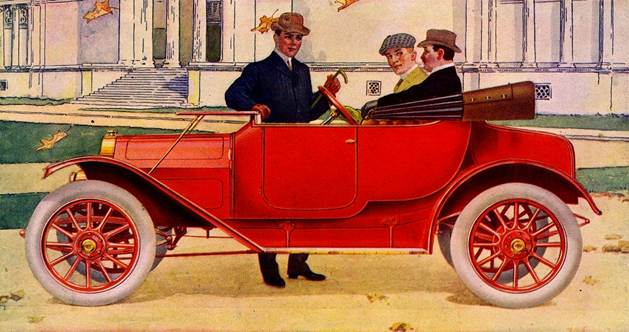
1912 Waverley Roadster
1913 was a tough year for North America’s heartland, with a sharp recession accompanied by record spring floods and severe winter blizzards throughout the Great Lake states.
At the Waverley Company’s annual meeting on December 10, 1913, it was declared a prosperous year, with $1,312,815.94 in gross receipts against $441,336.64 spent on salaries and wages. The surplus, including undistributed profits, was $590,000.
By the mid-teens, Waverley cars were becoming harder to differentiate from the competition. Design across the industry had standardized, with enclosed Coupés using worm gears or the newer spiral-bevel type shaft-drives. Lower priced competition came to market, such as the Milburn and the new line of light-chassis Detroit Electrics, driving down profit margins. The luxury gasoline car brands that electrics competed with had become much more civilized in comfort and reliability, with electrical systems for starting and lighting.
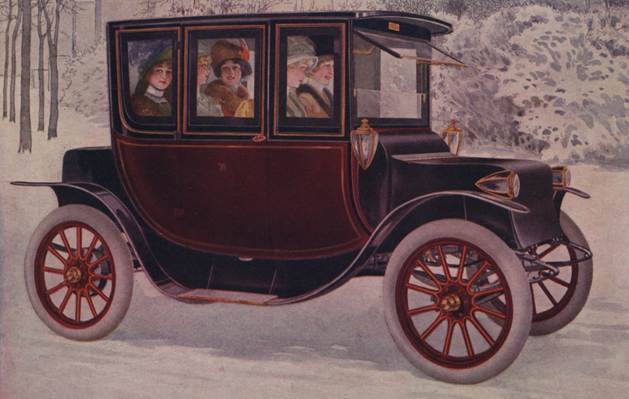
1913 Waverley Model 98, Limousine-5
1916 was the last year for Waverley cars as the United States shifted to a war economy. All they offered was the Brougham, with two different seating arrangements. This last iteration of the Waverley was a full thousand pounds lighter than the previous year’s model.
The company went on for a while longer; taking in metal fabrication and forge work on contract.
Albert Augustus Pope, who liked to be addressed by the honorarium Colonel, passed away August 10, 1909. Albert G. Spalding and James S. Conwell – a descendent of Betsy Ross – both moved to Southern California. When Conwell died, in December of 1917, he was President of the Los Angeles City Council. Spalding, with his new wife, built an impressive ocean view estate and pursued Theosophy near San Diego.
Version 3.10